Match the column I with column II and select the correct option.
| Column I | (Pair of isomers) |
| Column II | (Type of | isomerism) | |||||
Column I | |||||||||||
(Pair of isomers) | |||||||||||
Column II | |||||||||||
(Type of | |||||||||||
isomerism) | |||||||||||
(p) | 1. | Ionisation | |||||||||
(q) | 2. | Hydrate | |||||||||
(r) |
| (V) | (VI) | 3. | Coordination | ||||||
(V) | |||||||||||
(VI) | |||||||||||
(s) | 4. | Geometrical | |||||||||
5. | Linkage |





Text Solution
Verified by ExpertsC
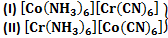
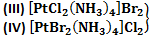
: Compounds (I) and (II) both contain complex cation and anion, so they show coordination isomerism. Compounds (III) and (IV) are obtained by the interchange of groups outside the coordination sphere and the ligands within the coordination sphere. Therefore, they give different ions in the solution. Hence, they show ionisation isomerism. Compounds (V) and (VI) are linkage isomers, because the ambidentate ligand,  has two donor atoms, i.e., it has two possibilities of attachment (-SCN and - NCS) with the central metal. Hence, they show linkage isomerism.
Compounds (VII) and (VIII) are obtained by the replacement of a coordinated group such as  by water of hydration. Hence, they show hydrate isomerism.
Prepare Smarter with CGP Edu
Get practice questions, solutions, and test series in one place.
Write a Review
Share your experience with this question and solution.
Commentary
Send your comment, doubt, correction, or feedback to admin.
Similar Questions
Explore conceptually related problems