The number of possible isomeric products formed when 3-chloro-l-butene reacts with HC1 through carbocation formation is.........
Text Solution
Verified by Experts4
(4) 3-chloro-l-butene undergo protonation and gives secondary carbocation according Markonikov's addition in the first step. In the second step the lone pair on the chlorine attacks the positively charged carbon to form cyclic intermediate. Now the nucleophile in the reaction i.e., chloride ion attacks cyclic intermediate and forms two structural products as shown below.
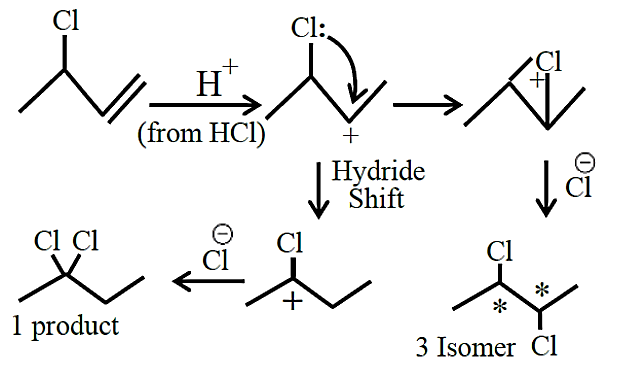
2,2-dichlorobutane exit in single isomer only, but 2,3-dichlorobutane exhibits three isomers.
Prepare Smarter with CGP Edu
Get practice questions, solutions, and test series in one place.
Write a Review
Share your experience with this question and solution.
Commentary
Send your comment, doubt, correction, or feedback to admin.
Similar Questions
Explore conceptually related problems