Sickle cell anaemia disease is an example of which type of gene mutation?
Text Solution
Verified by ExpertsB
Sickle-cell disease is caused by a single point mutation (a missense mutation) in the beta-hemoglobin gene that converts a GAG codon into GUG, which encodes the amino acid valine rather than glutamic acid. Transversion, refers to a point mutation in DNA in which a single (two ring) purine (A or G) is changed for a (one ring) pyrimidine (T or C), or vice versa. A transversion can be spontaneous, or it can be caused by ionizing radiation or alkylating agents.
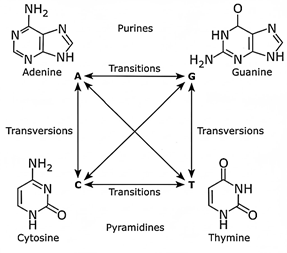
Transition, refers to a point mutation that changes a purine nucleotide to another purine  , or a pyrimidine nucleotide to another pyrimidine
  . Approximately two out of three single nucleotide polymorphisms (SNPs) are transitions.
A substitution mutation occurs when specific bases (A, T, C or G) in a gene are swapped for different ones. This type of mutation doesn't cause a difference in the number of bases like insertion or deletion mutations do. Substitution mutations just switch out one or more bases for different ones.
Polyploidy, the condition in which a normally diploid cell or organism acquires one or more additional sets of chromosomes. In other words, the polyploid cell ororganism has three or more times the haploid chromosome number.
Prepare Smarter with CGP Edu
Get practice questions, solutions, and test series in one place.
Write a Review
Share your experience with this question and solution.
Commentary
Send your comment, doubt, correction, or feedback to admin.
Similar Questions
Explore conceptually related problems