Let a, b, c be non-zero real number such that  =
=  Then the quadratic equation ax 2 + bx + c = 0 has -
Text Solution
Verified by ExpertsB
Let ƒ(x) = (1 + cos 8 x) (ax 2 + bx + c)
We are given  dx =
dx =  dx
dx
⇒  dx =
dx =  dx +
dx +  dx
dx
⇒  dx = 0
If ƒ(x) > 0 (ƒ(x) < 0) ∀ x ∈ [1, 2],
Then  dx > 0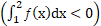
But 
∴ ƒ(x) is partly positive and partly negative on [1, 2].
⇒ there exist α , β ∈ [1, 2] such that
ƒ( α ) > 0 and ƒ( β ) < 0.
As ƒ is continuous on [1, 2] there exists γ lying between α and β (and hence between 1 and 2) such that ƒ( γ ) = 0
⇒ (1 + cos 8 γ ) (a γ 2 + b γ + c) = 0
⇒ a γ 2 + b γ + c = 0 [ 1 + cos 8 γ ≥ 1]
Thus, ax 2 + bx + c = 0 has at least one root in [1, 2].
Prepare Smarter with CGP Edu
Get practice questions, solutions, and test series in one place.
Write a Review
Share your experience with this question and solution.
Commentary
Send your comment, doubt, correction, or feedback to admin.
Similar Questions
Explore conceptually related problems