Published by:
CGP EDU Academic Team
Published on: August 14, 2026
If f(x) =  ; g(x) =
  for a > 1, a ≠ 1and x ∈ R, where { } & [ ] denote the fractional part and integral part functions respectively, then which of the following statements holds good for the function h(x), where ( λ n a) h(x) = ( λ n f(x) + λ n g(x)).
Text Solution
Verified by ExpertsThe correct answer is:
D
f(x) =  ; g(x) =
for a > 1, a ≠ 1 and x ∈ R
λ n a h(x) = λ n f(x) + λ ng(x)
⇒ ( λ n a) h(x) =  λ na +
  λ n a
λ n a
⇒ h(x) =  +
+ 
⇒ h(x) = a |x| sgn x
Now h(–x) = a |–x| sgn (–x) = –h(x)
⇒ h(x) is an odd function
Also graph of h(x) is
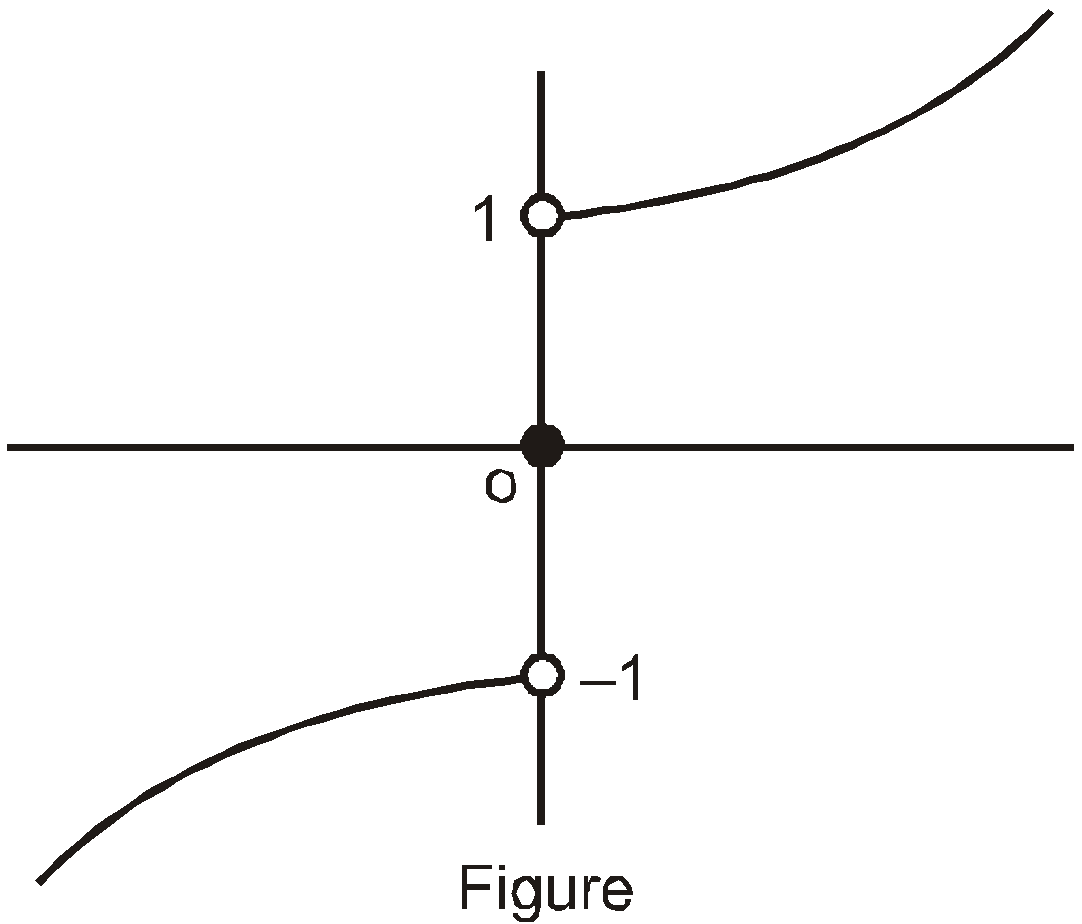
It is clear from the graph that h(x) is an increasing
function
Prepare Smarter with CGP Edu
Get practice questions, solutions, and test series in one place.
Write a Review
Share your experience with this question and solution.
Commentary
Send your comment, doubt, correction, or feedback to admin.
Similar Questions
Explore conceptually related problems
If f(x) = cos π x + 10x + 3x 2 + x 3 , – 2 ≤ x ≤ 3 then absolute minimum value of f(x) is-
The function f(x) = x 5 – 5x 4 + 5x 3 – 1 has-
The function f(x) = has no extrema. if (n ∈ z)
If x exceeds by its square by the greatest possible quantity then x is-
An extreme value of the function
f(x) = (sin –1 x) 3 + (cos –1 x) 3 (–1 < x < 1) is
Let f(x) = (t + 4) 4 log (t+ 1) dt, then -