Published by:
CGP EDU Academic Team
Published on: August 13, 2026
The quadratic equation (1 - sin  )x 2 + 2(1 - sin
  )x - 3 sin
  = 0 has both roots complex for all
  lying in the interval
A

B

C

D

Text Solution
Verified by ExpertsThe correct answer is:
D
D = 4(l - sin  ) 2 + 4(1 - sin
  ) - 3sin
  <0
<0
 4(1 - sin
  )(l – sin
  + 3sin
  ) < 0
) < 0
 4(1 - sin
  )(l + 2sin
  ) < 0
) < 0
 8(sin
8(sin  - 1) (sin
  +
+  ) > 0
) > 0
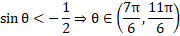
 sin
sin  <
<  or sin
  > 1
> 1
Prepare Smarter with CGP Edu
Get practice questions, solutions, and test series in one place.
Write a Review
Share your experience with this question and solution.
Commentary
Send your comment, doubt, correction, or feedback to admin.
Similar Questions
Explore conceptually related problems
Let P (x) = x 2 + bx + c, where b and c are integers. If P(x) is a factor of both x 4 + 6x 2 +25 an…
The value of which satisfy the equation (x - l) | x 2 - 4x + 3| + 2x 2 + 3x - 5 = 0 is
Consider the equation x 2 + 2x - n = 0, where n N and n [5, 100] . The number of different values…
The smallest possible natural number n, for which the equation x 2 - nx + 2014 = 0 has integral roo…
The value of a for which both the roots of the equation (l - a 2 )x 2 + 2ax - 1 = 0 lie between 0 a…
The sum of the real roots of the equation x 5 - 5x 4 + 9x 2 - 9x 2 + 5x - 1 = 0 is