Published by:
CGP EDU Academic Team
Published on: August 14, 2026
Consider an experiment of a single throw of a pair of unbiased normal dice. Let three events  and
and  are defined as follows
 : getting prime numbered face on each dice
 : getting the same number on each dice
 : getting the sum of 4 on two dice
Which of the following is not true?
A
The probabilities P (  ), P (
  ), P (
  ) are in arithmetic progression.
), P ( ), P ( ) are in arithmetic progression.
B
The events  and
and  are dependent
and are dependent
C

D

Text Solution
Verified by ExpertsThe correct answer is:
C

 = {(2,2) (2,3) (2,5), (3,2), (3,3), (3,5), (5,2), (5,3), (5,5)}
 = {(1,1) (2,2) (3,3), (4,4), (5,5), (6,6)}
 = {(1,3), (3,1), (2,2)}

 are in A.P.
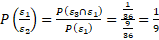
 (Dependent)
Prepare Smarter with CGP Edu
Get practice questions, solutions, and test series in one place.
Write a Review
Share your experience with this question and solution.
Commentary
Send your comment, doubt, correction, or feedback to admin.
Similar Questions
Explore conceptually related problems
A biased coin that has a probability of getting heads as p (0 < p < 1) is tossed until a head appea…
The minimum number of times a fair coin needs to be tossed, so that the probability of getting at l…
A bag contains a mixed lot of red and blue balls. If two balls are drawn at random, the probability…
If a 1 , a 2 , b 1 and b 2 take values in the set {1, -1,0}, then the probability that the equation…
A term is randomly chosen from the expansion of . If the probability that it is a rational term is…
A fair die is thrown n number of times. If the probability of always getting a number greater than …