Published by:
CGP EDU Academic Team
Published on: August 14, 2026
Let a > 0, b > 0 & c > 0. Then both the roots of the equation ax 2 + bx + c = 0
Text Solution
Verified by ExpertsThe correct answer is:
B
Since, 
and 
Case I: When 
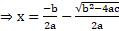 and
and  both roots, are negative.
Case II: When 
 , both roots are equal and negative
Case III: When 
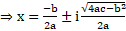 have negative real part.
∴ From above discussion both roots hare negative real parts.
──────────────────────────────────────────────────────────────────────────────────────────
Prepare Smarter with CGP Edu
Get practice questions, solutions, and test series in one place.
Write a Review
Share your experience with this question and solution.
Commentary
Send your comment, doubt, correction, or feedback to admin.
Similar Questions
Explore conceptually related problems
If the roots of are equal then
Let α α , β β be the roots of the equation , , then the roots of the equation are
Find the set of all real values of λ such that the root of the equation x 2 + 2(a + b + c)x + 3λ (a…
If for all , then belongs to the interval
If ' ' is real, then can take all real values if
If both roots of the quadratic equation are distinct & positive, then must lie in the interval: