Published by:
CGP EDU Academic Team
Published on: August 12, 2026
SECTION – 2 : Comprehension type (Only One Option Correct)
This section contains 3 paragraphs, each describing theory, experiments, data etc. Six questions relate to the three paragraphs with two questions on each paragraph. Each question has only one correct answer among the four given options
A
, 8 larger mean free path for X as compared to that of Y.
B
, 12 larger mean free path for Y as compared to that of X.
C
and 16 increased collision frequency of Y with the inert gas as compared to that of X with the inert gas.
D
. Paragraph for Questions (i) & (ii) X and Y are two volatile liquids with molar weights of 10 g mol -1 and 40 g mol -1 respectively. Two cotton plugs, one soaked in X and the other soaked in Y, are simultaneously placed at the ends of a tube of length L = 24 cm, as shown in the figure. The tube is filled with an inert gas at 1 atmosphere pressure and a temperature of 300 K. Vapours of X and Y react to form a product which is first observed at a distance d cm from the plug soaked in X. Take X and Y to have equal molecular diameters and assume ideal behaviour for the inert gas and the two vapours. 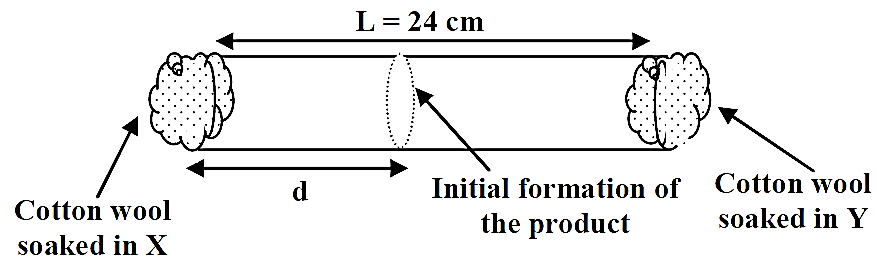 (i) The value of d in cm (shown in the figure), as estimated from Graham ’ s law, is 20 (ii) The experimental value of d is found to be smaller than the estimate obtained using Graham ’ s law. This is due to increased collision frequency of X with the inert gas as compared to that of Y with the inert gas.
(i) The value of d in cm (shown in the figure), as estimated from Graham ’ s law, is 20 (ii) The experimental value of d is found to be smaller than the estimate obtained using Graham ’ s law. This is due to increased collision frequency of X with the inert gas as compared to that of Y with the inert gas.
Text Solution
Verified by ExpertsThe correct answer is:
CHECK THE SOLUTION.
(i) 
d = 48 – 2d
3d = 48
d = 16cm
(ii) As the collision frequency increases then molecular speed decreases than the expected.
──────────────────────────────────────────────────────────────────────────────────────────
Prepare Smarter with CGP Edu
Get practice questions, solutions, and test series in one place.
Write a Review
Share your experience with this question and solution.
Commentary
Send your comment, doubt, correction, or feedback to admin.
Similar Questions
Explore conceptually related problems
INSTRUCTIONS Maximum Marks: 180
A. General
1. This booklet is your Question Paper. Do not break the…
A glass capillary tube is of the shape of truncated cone with an apex angle so that its two ends h…
If is the wavelength of X-ray line of copper (atomic number 29) and o is the wavelength of the …
A planet of radius (radius of Earth) has the same mass density as Earth. Scientists dig a well of …
A tennis ball is dropped on a horizontal smooth surface. It bounces back to its original position a…
A metal surface is illuminated by light of two different wavelengths 248 nm and 310 nm. The maximum…