A block of mass 2M is attached to a massless spring 2M with spring-constant k. This block is connected to two other blocks of masses M and 2M using two massless pulleys and strings. The accelerations of the blocks are a b a 2 and a 3 as shown in the figure, the system is released from rest with the spring in its unstretched state. The maximum extension of the spring is x 0 . Which of the following option(s) is/are correct?
[g is the acceleration due to gravity, neglect friction]
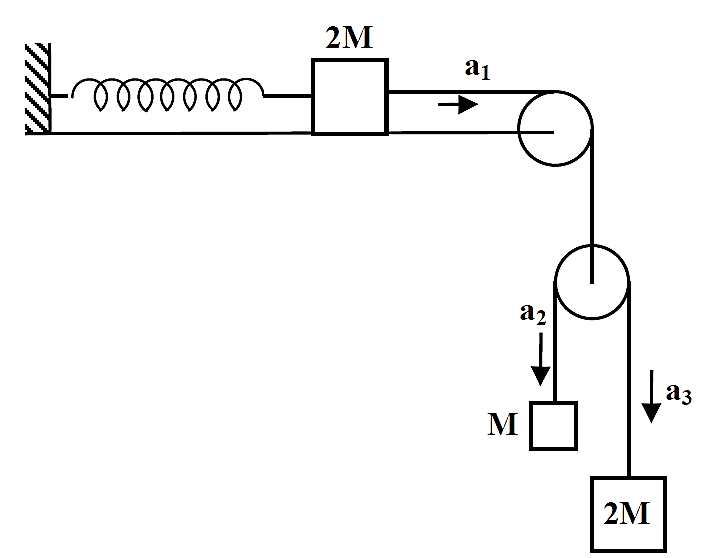
 of the spring, the magnitude of acceleration of the block connected to the spring is

 for the first time, the speed of the block connected to the spring is
  .
.
Text Solution
Verified by ExpertsA
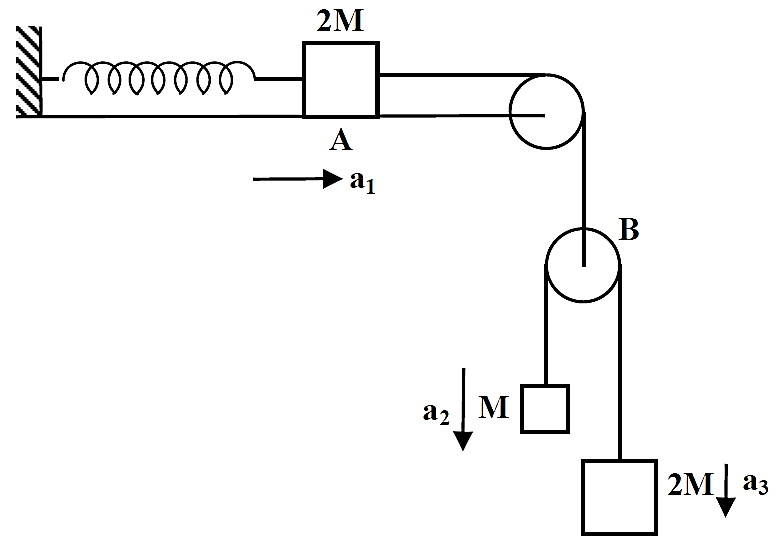
In the frame of pulley B, the hanging masses have accelerations : M  (a 2 – a 1 ), 2M
  (a 3 – a 1 ): downwar(d)
 (a 2 – a 1 ) = -(a 3 – a=) [constant] Assuming that the extension of the spring is x We consider the FED of A :
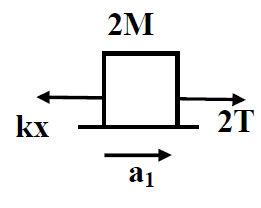

where  ...(i)
and the FED of the rest of the system in the frame of pulley B :
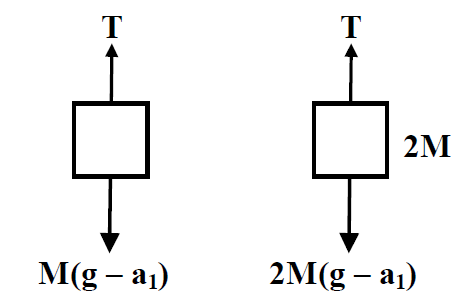
Upward acceleration of block M w.r.t. the pulley B = Downward acceleration of block 2M w.r.t the pulley

 ...(ii)
substituting in equation (i),we get
 ...(iii)
This is the equation of SHM
Maximum extension = 2 x Amplitude
i.e. 
At  , acceleration is easily found from equation (iii):


At  , speed of the block (2M) =
  x amplitude

 option is correct
──────────────────────────────────────────────────────────────────────────────────────────
Prepare Smarter with CGP Edu
Get practice questions, solutions, and test series in one place.
Write a Review
Share your experience with this question and solution.
Commentary
Send your comment, doubt, correction, or feedback to admin.
Similar Questions
Explore conceptually related problems