Let the functions f:(-l, 1)  R and g: (-1, 1)
  (-1, 1) be defined by
f(x) = |2x - 1| + |2x + 1| and g(x) = x - [x],
where [x] denotes the greatest integer less than or equal to x. Let fog :(-!, 1) -^ R be the composite function defined by (fog)(x) = f(g(x)). Suppose c is the number of points in the interval (-1,1) at which fog is NOT continuous, and suppose d is the number of points in the interval (—1,1) at which fog is NOT differentiable. Then the value of c + d is_____
Text Solution
Verified by Experts4
(4)
f(x) = |2x-l| + |2x+l|
g(x)={x}
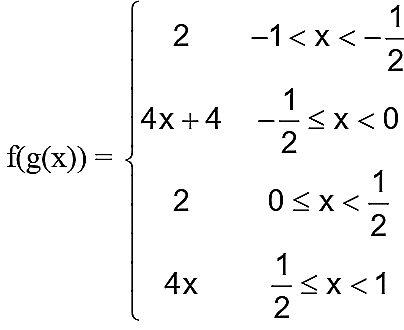
 Dis-continuous at x = 0
  c=l
c=l
 non-differentiable at x =
  d=3
d=3
 c + d = 4
──────────────────────────────────────────────────────────────────────────────────────────
Prepare Smarter with CGP Edu
Get practice questions, solutions, and test series in one place.
Write a Review
Share your experience with this question and solution.
Commentary
Send your comment, doubt, correction, or feedback to admin.
Similar Questions
Explore conceptually related problems