SECTION 2 (Maximum Marks: 24)
• This section contains SIX (06) questions.
• Each question has FOUR options ONE OR MORE THAN ONE of these four option(s) is(are) correct answer (s).
• For each question, choose the option(s) corresponding to (all) the correct answer (s).
• Answer to each question will be evaluated according to the following marking scheme:
Full Marks : +4 If only (all) the correct option(s) is(are) chosen;
Partial Marks : +3 If all the four options are correct but ONLY three options are chosen;
Partial Marks : +2 If three or more options are correct but ONLY two options are chosen, both
of which are correct;
Partial Marks : +1 If two or more options are correct but ONLY one option is chosen and it is a
correct option;
Zero Marks : 0 If none of the options is chosen (i.e. the question is unanswered);
Negative Marks : -2 In all other cases.
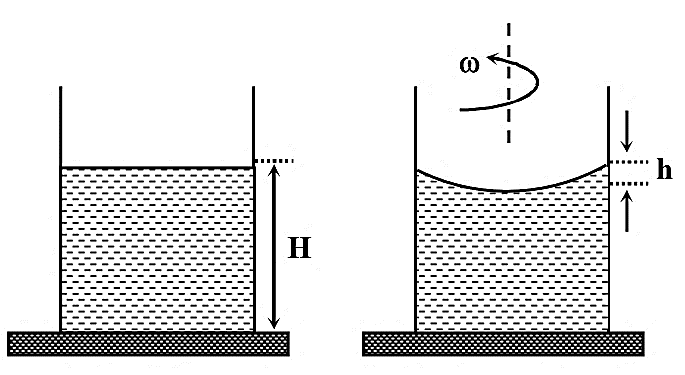
A beaker of radius r is filled with water  up to a height H as shown in the figure on the left. The beaker is kept on a horizontal table rotating with angular speed
  . This makes the water surface curved so that the difference in the height of water level at the center and at the circumference of the beaker is h(h<<H, h<<r), as shown in the figure on the spherical with a radius of curvature R. Which of the following is/are correct? (g is the acceleration due to gravity)




Text Solution
Verified by ExpertsCHECK THE SOLUTION.
(a, d)
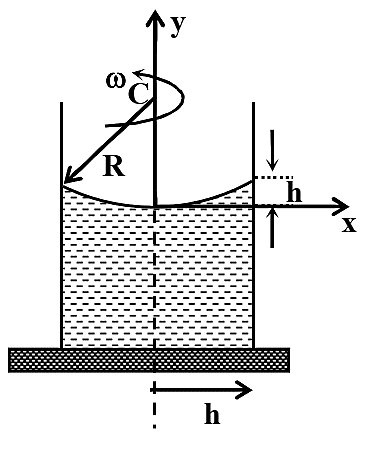


Pythagoras  r 2 + (R - h) 2 = R 2
 A option is correct
For apparent depth applying refraction formula

 D option is correct.
──────────────────────────────────────────────────────────────────────────────────────────
Prepare Smarter with CGP Edu
Get practice questions, solutions, and test series in one place.
Write a Review
Share your experience with this question and solution.
Commentary
Send your comment, doubt, correction, or feedback to admin.
Similar Questions
Explore conceptually related problems