Published by:
CGP EDU Academic Team
Published on: August 13, 2026
Consider, f(x) = tan–1  , g(x) = sin–1
  and h(x) = tan (cos–1(sinx)), then show that
(h(f(x)) + h(g(x)) = 
Text Solution
Verified by ExpertsThe correct answer is:
CHECK THE SOLUTION.
g(x) = 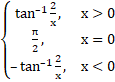
x > 0 h(f(x)) =  = h (g(x))
x < 0 , h(f(x)) =  , h (g(x)) =
──────────────────────────────────────────────────────────────────────────────────────────
Prepare Smarter with CGP Edu
Get practice questions, solutions, and test series in one place.
Write a Review
Share your experience with this question and solution.
Commentary
Send your comment, doubt, correction, or feedback to admin.
Similar Questions
Explore conceptually related problems
Evaluate the following expressions :
(i) sin
(ii) tan
(iii) cosec
(iv) tan
(v) sin
(vi) cos
(…
Find the value of sin–1 (cos(sin–1x)) + cos–1 (sin (cos–1x))
If tan –1 x + cot –1 + 2tan –1 z = π , then prove that x + y + 2z = xz2 + yz2 + 2xyz
If , then prove that
Prove each of the following relations :
(i)tan–1 x = – π + cot–1 = sin–1 = – cos–1 when x < 0.
(…
Express in terms of
(i) tan–1 to tan–1 x for x > 1
(ii) sin–1 (2x ) to sin–1 x for 1 ≥ x >
(iii)…