Published by:
CGP EDU Academic Team
Published on: August 13, 2026
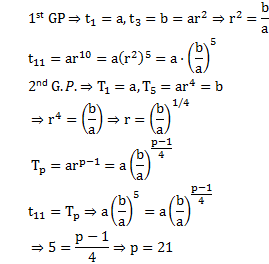
Let  and
and  be be two distinct positive real numbers. Let
  term of a GP, whose first term is
  and third term is
  , is equal to
  term of another GP, whose first term is a and fifth term is
  . Then
  is equal to
Text Solution
Verified by ExpertsThe correct answer is:
C
──────────────────────────────────────────────────────────────────────────────────────────
Prepare Smarter with CGP Edu
Get practice questions, solutions, and test series in one place.
Write a Review
Share your experience with this question and solution.
Commentary
Send your comment, doubt, correction, or feedback to admin.
Similar Questions
Explore conceptually related problems
Let be in A.P. and be in G.P. Then, the arithmetic mean of and is :
Let denote the sum of the first terms of an arithmetic progression. If and the ratio of the tent…
The number of common terms in the progressions , up to term and , up to term is :
The term from the end of the progression is :-
If in a G.P. of 64 terms, the sum of all the terms is 7 times the sum of the odd terms of the G.P, …
In an A.P., the sixth terms . If the is the greatest, then the common difference of the A.P., is …