SECTION-2 (Maximum Marks : 12)
• This section contains THREE (03) questions.
• Each question has FOUR options
Full Marks | +4 | ONLY if (all) the correct option(s) is(are) chosen; | |||
Partial Marks | +3 | If all the four options are correct but ONLY three options are chosen; | |||
Partial Marks | +2 | If three or more options are correct but ONLY two options are chosen, both of which | |||
Partial Marks | +1 |
| If two or more options are correct but ONLY one option is chosen and it is a correct option; | ||
If two or more options are correct but ONLY one option is chosen and it is a correct option; | |||||
Zero Marks | 0 | If none of the options is chosen (i.e. the question is unanswered); | |||
Negative.Marks | -2 | In all other cases. |


 orbital of an atom is lower than the energy of an electron that is infinitely far away from the nucleus.
 , which corresponds to the most stable orbit.
 .
.
Text Solution
Verified by ExpertsCHECK THE SOLUTION.
(a, b, c)
Uncertainty principle rules out existence of definite paths or trajectories of electron and other similar particles. So, option is correct.
Shell or orbit more near to nucleus has less energy than faraway. So, option is also correct.
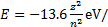 atom
atom
So,  has most negative energy.
So, option is also correct.

when  increases velocity decreases.
So, option is incorrect.
──────────────────────────────────────────────────────────────────────────────────────────
Prepare Smarter with CGP Edu
Get practice questions, solutions, and test series in one place.
Write a Review
Share your experience with this question and solution.
Commentary
Send your comment, doubt, correction, or feedback to admin.
Similar Questions
Explore conceptually related problems