Published by:
CGP EDU Academic Team
Published on: August 12, 2026
SECTION-2 ( Maximum Marks : 12)
• This section contains THREE (03) questions.
• Each question has FOUR options
A
, The dipole will undergo small oscillations at any finite value of  .
.
.
B
, The dipole will undergo small oscillations at any finite value of  .
.
.
C
and The dipole will undergo small oscillations with an angular frequency of  at
at 
at
D
. ONE OR MORE THAN ONE of these four option(s) is(are) correct answer(s). • For each question, choose the option(s) corresponding to (all) the correct answer(s) • Answer to each question will be evaluated according to the following marking scheme: Full Marks :  ONLY if (all) the correct option(s) is(are) chosen; Partial Marks :
  If all the four options are correct but ONLY three options are chosen; Partial Marks : +2 If three or more options are correct but ONLY two options are chosen, both of which are correct; Partial Marks : +1 If two or more options are correct but ONLY one option is chosen and it is a correct option; Zero Marks : 0 If unanswered; Negative Marks : -2 In all other cases. A small electric dipole
  , having a moment of inertia / about its center, is kept at a distance
  from the center of a spherical shell of radius
  . The surface charge density
  is uniformly distributed on the spherical shell. The dipole is initially oriented at a small angle
  as shown in the figure. While staying at a distance
  , the dipole is free to rotate about its center.
 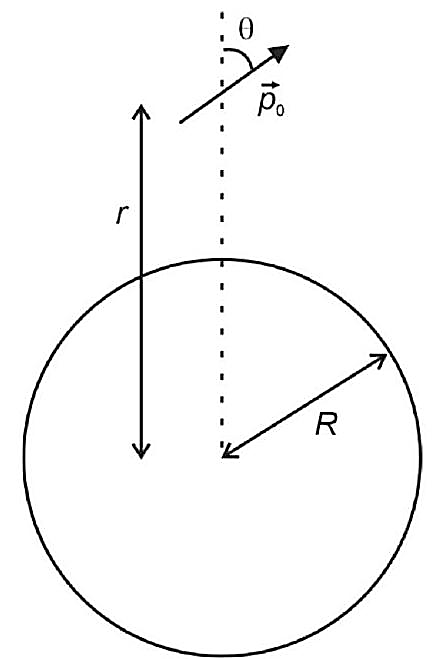 If released from rest, then which of the following statement(s) is (are) correct? [
  is the permittivity of free space.] The dipole will undergo small oscillations with an angular frequency of
 ![]() at
at 
ONLY if (all) the correct option(s) is(are) chosen; Partial Marks : If all the four options are correct but ONLY three options are chosen; Partial Marks : +2 If three or more options are correct but ONLY two options are chosen, both of which are correct; Partial Marks : +1 If two or more options are correct but ONLY one option is chosen and it is a correct option; Zero Marks : 0 If unanswered; Negative Marks : -2 In all other cases. A small electric dipole , having a moment of inertia / about its center, is kept at a distance from the center of a spherical shell of radius . The surface charge density is uniformly distributed on the spherical shell. The dipole is initially oriented at a small angle as shown in the figure. While staying at a distance , the dipole is free to rotate about its center. If released from rest, then which of the following statement(s) is (are) correct? [ is the permittivity of free space.] The dipole will undergo small oscillations with an angular frequency of
Text Solution
Verified by ExpertsThe correct answer is:
CHECK THE SOLUTION.
(b, d)
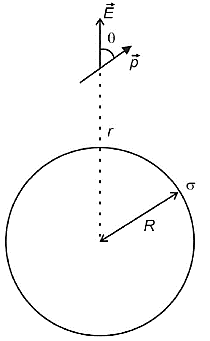


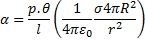
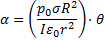

For
 (C is incorrect)
Also, for
(D is correct)
It will oscillate for any finite value of  . (B is correct)
──────────────────────────────────────────────────────────────────────────────────────────
Prepare Smarter with CGP Edu
Get practice questions, solutions, and test series in one place.
Write a Review
Share your experience with this question and solution.
Commentary
Send your comment, doubt, correction, or feedback to admin.
Similar Questions
Explore conceptually related problems
PHYSICS
SECTION -1 (Maximum Marks : 12)
• This section contains FOUR (04) questions.
• Each questio…
A particle of mass is under the influence of the gravitational field of a body of mass . The part…
A metal target with atomic number is bombarded with a high energy electron beam. The emission of X…
A thin stiff insulated metal wire is bent into a circular loop with its two ends extending tangenti…
A table tennis ball has radius and mass . It is slowly pushed down into a swimming pool to a dept…
A positive, singly ionized atom of mass number is accelerated from rest by the voltage . Thereaft…