If  is finite, then (a + b) is equal to:


Text Solution
Verified by ExpertsD
To find the value of  for which the following limit is finite:
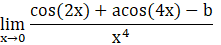
we start by expanding the cosine functions using their Taylor series:
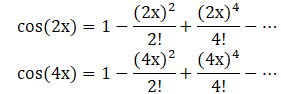
Substitute these expansions into the limit expression:

To ensure that the limit is finite, the linear and quadratic terms must sum to zero. Let's equate the constant terms first:
For the limit to be finite:
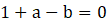
Equating the coefficients of  :
:

Solving the second equation, we have:
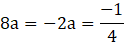
Substitute  back into the first equation to find
  :
:

Thus, the sum of  and
and  is:
is:
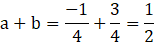
Therefore, the correct value of  is
is  .
.
──────────────────────────────────────────────────────────────────────────────────────────
Prepare Smarter with CGP Edu
Get practice questions, solutions, and test series in one place.
Write a Review
Share your experience with this question and solution.
Commentary
Send your comment, doubt, correction, or feedback to admin.
Similar Questions
Explore conceptually related problems