Published by:
CGP EDU Academic Team
Published on: August 22, 2026
Match List I with List II
| List I | Element detected |
| List II | Reagent used/ | Product formed | |||||
List I | |||||||||||
Element detected | |||||||||||
List II | |||||||||||
Reagent used/ | |||||||||||
Product formed | |||||||||||
Nitrogen | I. | ||||||||||
Sulphur | II. | ||||||||||
Phosphorous | III. | ||||||||||
Halogen | IV. |




Choose the correct answer from the options given below:
Text Solution
Verified by ExpertsThe correct answer is:
D
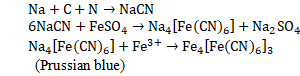
Nitrogen detection by lassaigne's method
Sulphur detection by Sodium nitroprusside

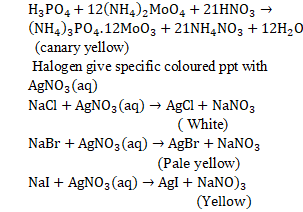
Phosphorus detection by ammonium molybdate

──────────────────────────────────────────────────────────────────────────────────────────
Prepare Smarter with CGP Edu
Get practice questions, solutions, and test series in one place.
Write a Review
Share your experience with this question and solution.
Commentary
Send your comment, doubt, correction, or feedback to admin.
Similar Questions
Explore conceptually related problems
PART-I PHYSICS
SECTION-A
For the plane electromagnetic wave given by and , the ratio of average e…
Name the logic gate equivalent to the diagram attached
A small ball of mass and density is dropped in a viscous liquid of density . After some time, th…
The number of air molecules per increased from to . The ratio of collision frequency of air mole…
A source supplies heat to a system at the rate of . If the system performs work at a rate of . Th…
A particle is moving with constant speed in a circular path. When the particle turns by an angle ,…