Water in a clean aquarium forms a meniscus, as illustrated in the figure.

Calculate the difference in height h between the centre and the edge of the meniscus. The surface tension of water is γ = 0.073 N m –1 .
Text Solution
Verified by ExpertsCHECK THE SOLUTION.
Sol. The pressure of the water changes linearly with the increase in height. At the bottom of the meniscus it is equal to the external atmospheric pressure p 0 , and at the top to p 0 – ρ gh. The average pressure exerted on the wall is p average = p 0 – ρ gh/2. The force corresponding to this value, for an aquarium with side walls of length λ , is F 1 = λ p average h.
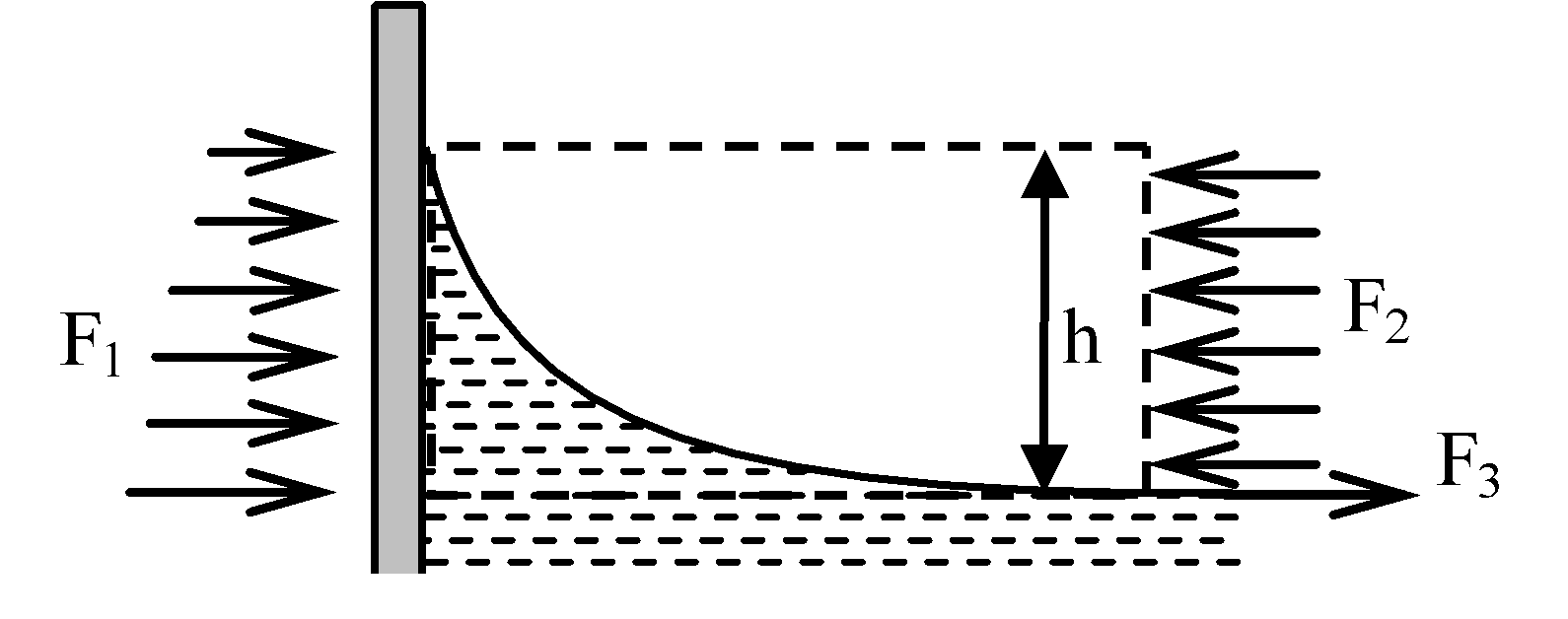
Consider the horizontal forces acting on the volume of water enclosed by the dashed lines in the figure. The wall pushes it to the right with force F 1 , the external air pushes it to the left with force F 2 = λ p 0 h, and the surface tension of the rest of the water pulls it to the right with a force F 3 = λ γ . The resultant of these forces has to be zero, since the volume itself is at rest. This means that
 λ h – p 0 λ h + λ γ = 0,
which we can write as
h =  =
=  = 0.0038 m.
Water rises by approximately 4 mm up the wall of the aquarium.
Prepare Smarter with CGP Edu
Get practice questions, solutions, and test series in one place.
Write a Review
Share your experience with this question and solution.
Commentary
Send your comment, doubt, correction, or feedback to admin.
Similar Questions
Explore conceptually related problems