A conical glass capillary tube A of length 0.1 m has diameters 10 –3 m and 5 × 10 –4 m at the ends. When it is just immersed in a liquid at 0ºC with larger diameter in contact with it, the liquid rises to 8 × 10 –2 m in the tube. In another cylindrical glass capillary tube B, when immersed in the same liquid at 0ºC, the liquid rises to 6 × 10 –2 m height. The rise of liquid in the tube B is only 5.5 × 10 –2 m when the liquid is at 50ºC. Find the rate at which the surface tension changes with temperature, considering the change to be linear. The density of liquids is (1/14) × 10 4 kg/m 3 and the angle of contact is zero. (Effect of temperature on the density of liquid and glass is negligible). (g = 9.8 N/kg.)
Text Solution
Verified by ExpertsCHECK THE SOLUTION.
(1860 N/m 2 )
Sol.
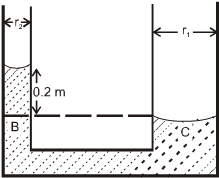
r 1 = 1.44 × 10 –3 m., r 2 = 0.72 × 10 –3 m.
Equating pressures at points &
P A –  + (0.2) ρ g = P C . and P B –
  = P C .
so P B – P A = 2 σ  + 0.2 ρ g
= 2 × 72 × 10 –3 
 + (0.2) × 10 3 × 9.8
=  + 1960
= – 100 + 1960 = 1860 N/m 2 .
Prepare Smarter with CGP Edu
Get practice questions, solutions, and test series in one place.
Write a Review
Share your experience with this question and solution.
Commentary
Send your comment, doubt, correction, or feedback to admin.
Similar Questions
Explore conceptually related problems