In a voltaic cell, electric energy is produced at the cost of chemical reactions. From thermodynamic
consideration we know that the amount of electrical energy produced under reversible conditions is equal to the free energy decrease. But if the electrode processes are irreversible , the electrical energy output will be less than the decrease in free energy because a portion of the free energy will be dissipated at heat. The opposite non spontaneous process, namely the chemical reaction at the cost of electrical energy, under reversible conditions, the free energy changes, though opposite in sign, would be equal in magnitude in the two opposite transformations. But in most of our practical observations, which are generally rapid, the conditions of reversibility is not observed. The applied potential necessary for the electrolysis would be greater than the reversible emf of the corresponding voltaic cell. This phenomenon is known as "polarisation" and extra voltage needed is known as "polarisation voltage".
In the given figure 1(M) H 2 SO 4 solution is
decomposed by using Pt electrodes as per the given arrangements
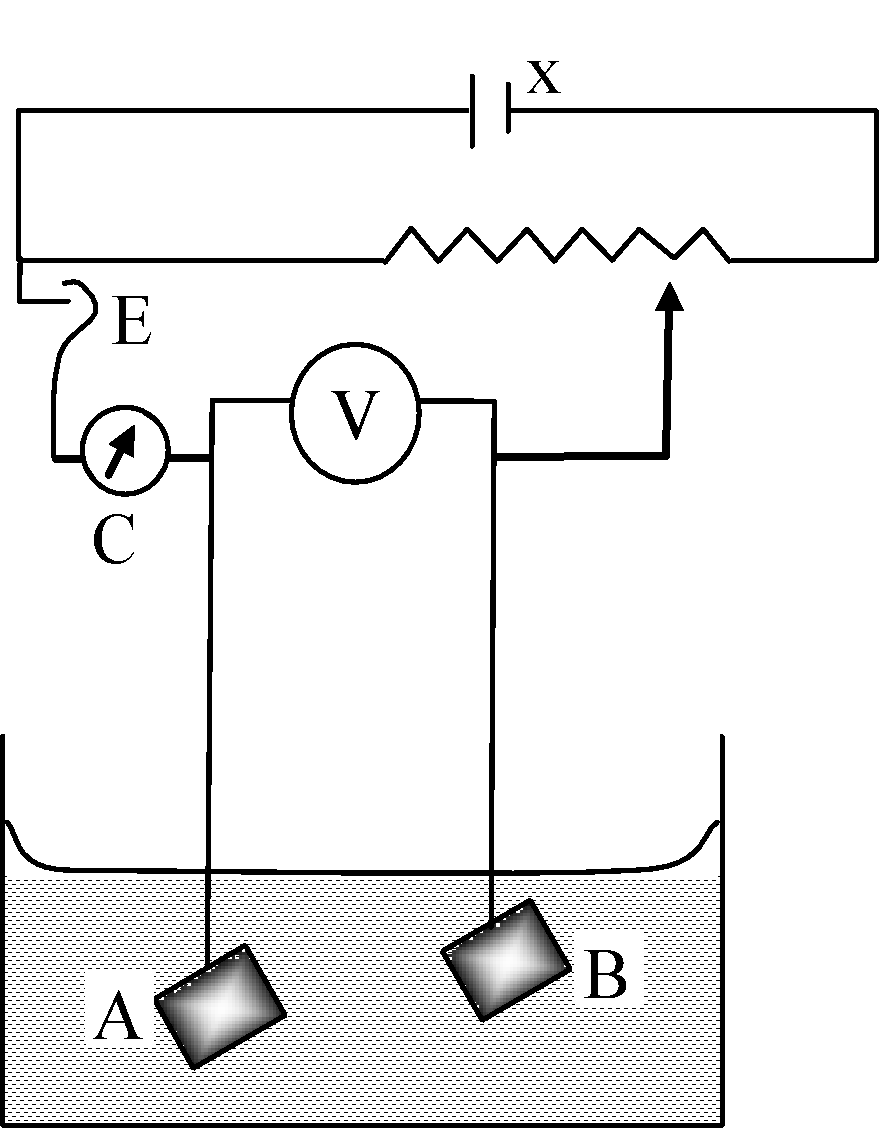
A & B are Pt electrodes inserted in the acid solution x is the external battery , C is milliammeter , E is key
The voltameter V is connected to the two electrodes to measure the potential difference between the two electrodes at any moment.
(i) In the given electrolysis which of the following would occur by applying small voltage initially?
Text Solution
Verified by ExpertsCHECK THE SOLUTION.
(i)
Sol. All of the above phenomenon would occur
(ii)
Sol.

(iii)
Sol. inert electrode have been converted to oxygen and hydrogen electrode and the e.m.f of the H 2 -O 2 voltaic cell has an opposite emf to the external voltage
(iv)
Sol. E = Eº – 0.059 log[H + ] [OH – ]
E = 0.403 – 0.059 log (10 –14 ) = 1.23 volt
∴ polarisation voltage = 1.7 – 1.23 = 0.47 V
(v)
Sol. all of the above
Prepare Smarter with CGP Edu
Get practice questions, solutions, and test series in one place.
Write a Review
Share your experience with this question and solution.
Commentary
Send your comment, doubt, correction, or feedback to admin.
Similar Questions
Explore conceptually related problems