Published by:
CGP EDU Academic Team
Published on: August 11, 2026
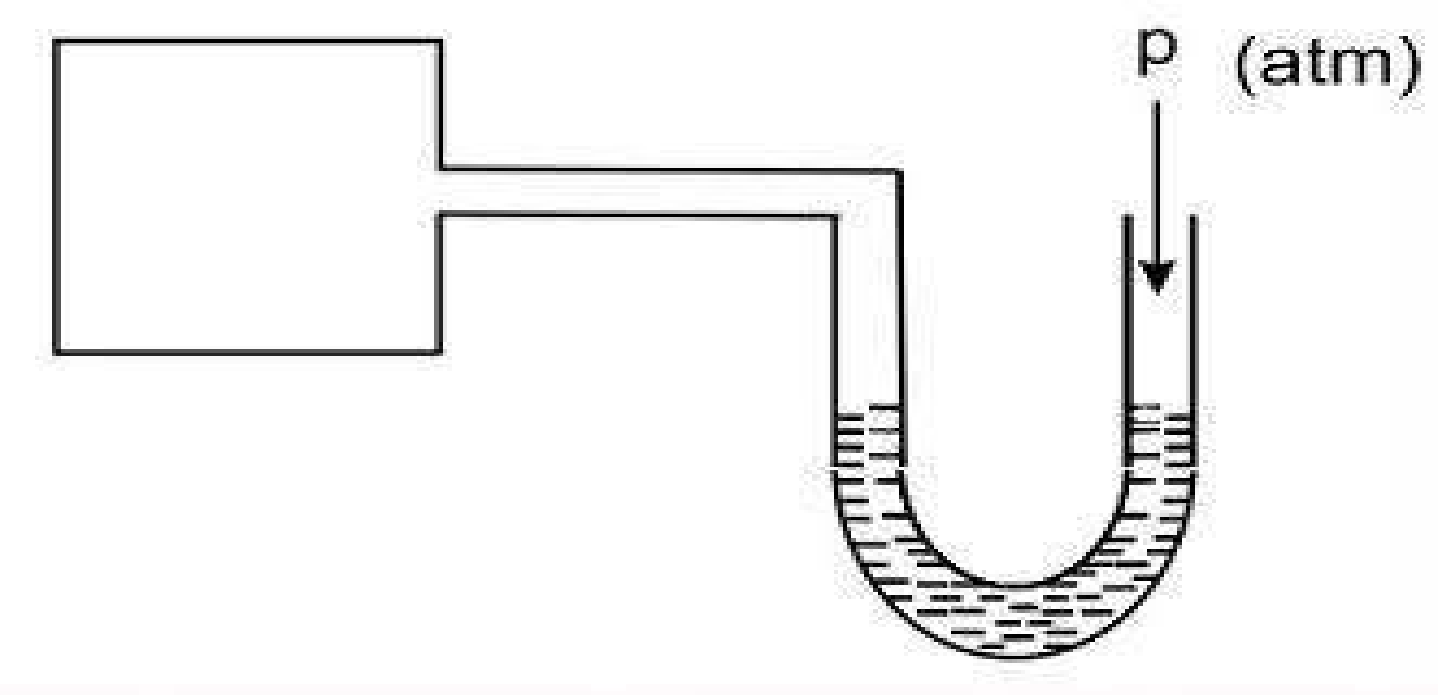
An open manometer attached to a flask containing ammonia gas have no difference in mercury level initially as shown in diagram. After sparking into the flask, ammonia is partially dissociated as 2NH 3 (g)  N 2 (g) + 3H 2 (g). Now it have difference of 18 cm in mercury level in two columns, what is partial pressure of H 2 (g) at equilibrium ?
Text Solution
Verified by ExpertsThe correct answer is:
C
27cmofHg
2NH 3 (g)  N 2 (g) + 3H 2
76 - 2x x 3x
76 + 2x = 76 + 18
2x = 18
 x = 9
x = 9


= 27 cm of Hg
Prepare Smarter with CGP Edu
Get practice questions, solutions, and test series in one place.
Write a Review
Share your experience with this question and solution.
Commentary
Send your comment, doubt, correction, or feedback to admin.
Similar Questions
Explore conceptually related problems
N 2 + 3H 2 2NH 3
1 mole N 2 and 4 moles H 2 are taken in 15L flask at 27°C. After complete convers…
The reduced temperature
The reduced pressure
The reduced volume
Hence, it can be said that the r…
For one mole of a van der Waals when b = 0 and T = 300 K, the PV vs. 1/V plot is shown below. The v…
According to the kinetic theory of gases, between two successive collisions, a gas molecule travels
The van der Waal's constant V of a gas is 4 x 10 -4 L/mol. How near can the centres of the two mol…
An open vessel at 27° C is heated until 3/8th of the air in it has been expelled. Assuming that the…