In the photoelectric effect the electrons are emitted instantaneously from a given metal plate, when it is irradiated with radiation of frequency equal to or greater than some minimum frequency, called the threshold frequency. According to planck's idea, light may be considered to be made up of discrete particles called photons. Each photon carries energy equal to h ν . When this photon collides with the electron of the metal, the electron acquires energy equal to the energy of the photon. Thus the energy of the emitted electron is given by :
h ν = K.E maximum + P. E. =  mu 2 + PE
If the incident radiation is of threshold frequency the electron will be emitted without any kinetic energy i.e. h ν 0 = PE
∴  mu 2 = h ν – h ν 0
A plot of kinetic energy of the emitted electron versus frequency of the incident radiation yields a straight line given as
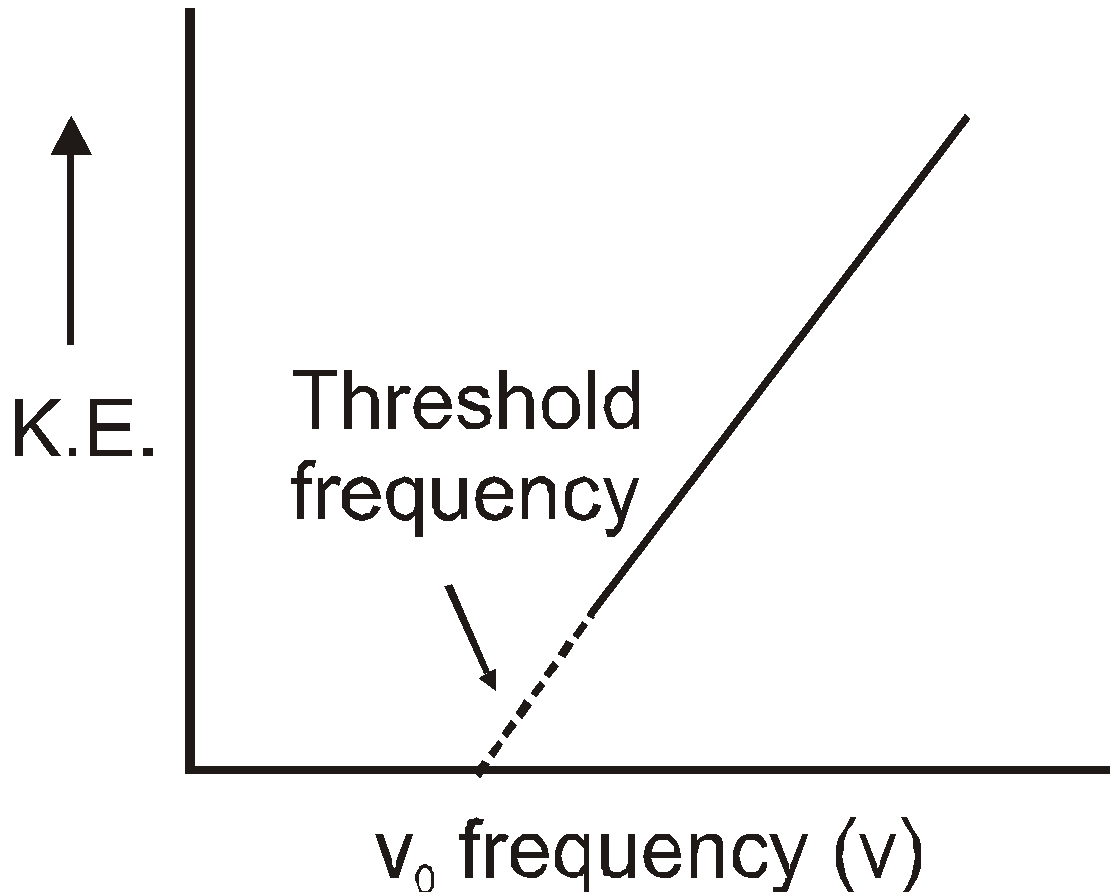
(i) A beam of white light is dispersed into its wavelength components by a Quartz prism and falls on a thin sheet of potassium metal. What is the correct decreasing order of maximum kinetic energy of the electron emitted by the different light component?
Text Solution
Verified by ExpertsCHECK THE SOLUTION.
(i)B
As the frequency of incident radiations increases, the kinetic energy of emitted photoelectrons increases.
Decreasing order of ν ⇒ Violet > Blue > Orange > Red
Decreasing order of KE of photoelectrons ⇒ Violet > Blue > Orange > Red
(ii)C
The interaction between photon and electron is always one to one for ejection of photoelectrons, Frequency of incident radiations > threshold frequency
5.16 x 10 15 > 6.15 × 10 14 (iii)A
The number of photoelectrons emitted depend on the intensity or brightness of incident radiation.
Prepare Smarter with CGP Edu
Get practice questions, solutions, and test series in one place.
Write a Review
Share your experience with this question and solution.
Commentary
Send your comment, doubt, correction, or feedback to admin.
Similar Questions
Explore conceptually related problems