Salt and water is formed by acid-base neutralisation reaction. If ratio of moles of acid & base taken is not similar to the ratio of their stoichiometric coefficient, then one of the component is limiting reagent. Assume no dissociation of water in following reactions. (Base is 80% pure only, take impurity present as inert & non electrolytic) (Molecular mass of Cs = 133, I = 127, Rb = 85.5, Sr = 88)
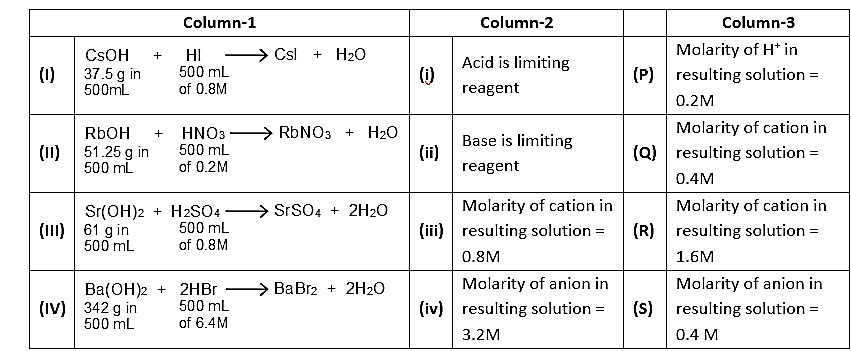
(i) Select correct combination for the resulting basic solution.
Text Solution
Verified by ExpertsCHECK THE SOLUTION
(i) Mass of pure CsOH =  = 30 g
CsOH + HI ⎯→ CsI + H 2 O

 – –
– –
0.2 mole 0.4 mole
0 0.2 mole 0.2 mole
Base in L.R., [H + ] = 0.2 M [Cs + ] = 0.2 M [I – ] = 0.4 M
(ii) RbOH pure =  = 41 g
RbOH + HNO 3 ⎯→ RbNO 3 + H 2 O

 – –
– –
0.4 mole 0.1 mole
0.3 mole 0 0.1 mole
Acid in L.R., [OH – ] = 0.3M [Rb + ] = 0.4M [NO 3 – ] = 0.1M
(iii) Sr(OH) 2 + H 2 SO 4 ⎯→ SrSO 4 + 2H 2 O [Pure Sr(OH) 2 = 61 × 0.8 = 48.8 gm]

 – –
– –
0.4 mole 0.4 mole
– – 0.4 mole
[Sr 2+ ] = [SO 4 2– ] = 0.4 M
Prepare Smarter with CGP Edu
Get practice questions, solutions, and test series in one place.
Write a Review
Share your experience with this question and solution.
Commentary
Send your comment, doubt, correction, or feedback to admin.
Similar Questions
Explore conceptually related problems