Published by:
CGP EDU Academic Team
Published on: August 14, 2026
A manometer attached to a flask contains with ammonia gas have no difference in mercury level initially as shown in diagram. After sparking into the flask, ammonia is partially dissociated as 2NH 3 (g) ⎯→ N 2 (g) + 3H 2 (g) now it have difference of 6 cm in mercury level in two columns, what is partial pressure of H 2 (g) at equilibrium? 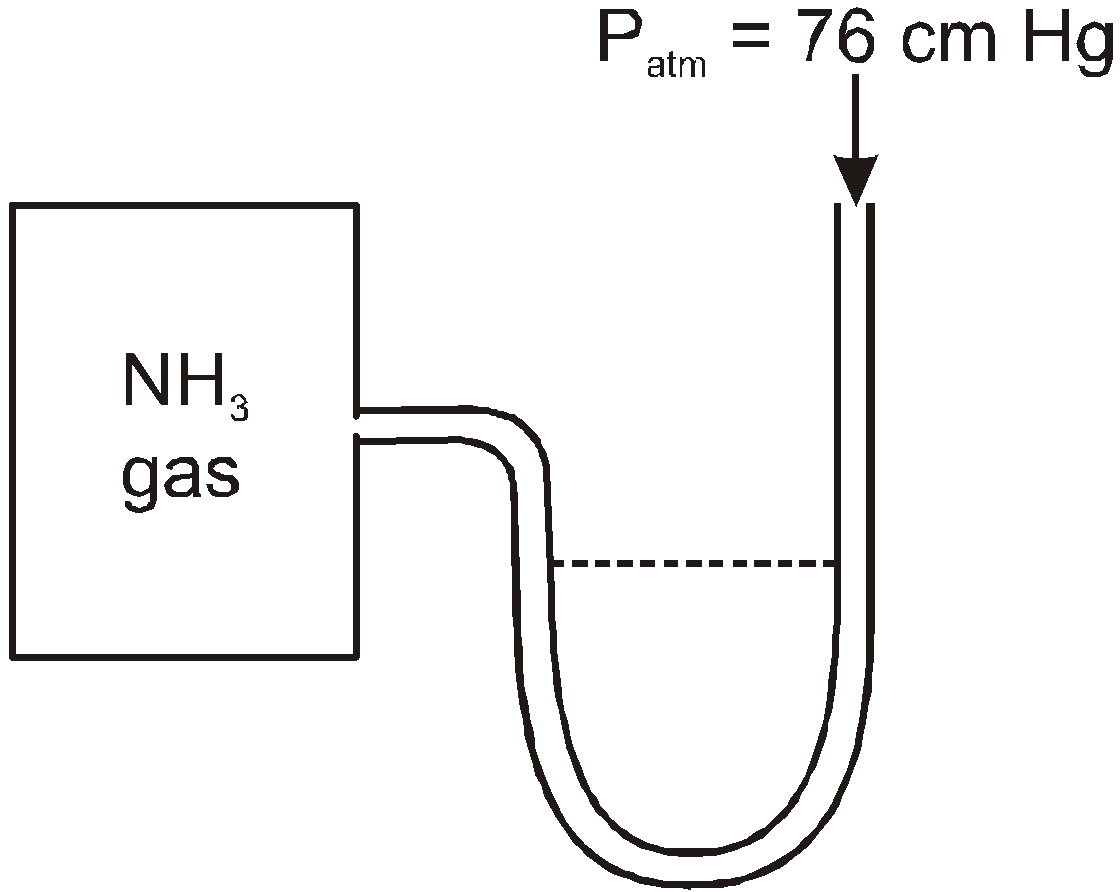
Text Solution
Verified by ExpertsThe correct answer is:
A
2NH 3 (g) ⎯→ N 2 (g) + 3H 2 (g)
Before sparking 76 0 0
After sparking at eqm 76 – 2x x 3x
Increase in pressure 2x = 18; x = 9 cm Hg
Partial pressure of H 2 = 3 × 3 = 9 cm Hg
Prepare Smarter with CGP Edu
Get practice questions, solutions, and test series in one place.
Write a Review
Share your experience with this question and solution.
Commentary
Send your comment, doubt, correction, or feedback to admin.
Similar Questions
Explore conceptually related problems
If P , V , T represent pressure, volume and temperature of the gas, the correct representation of B…
At constant temperature, in a given mass of an ideal gas
Air at sea level is dense. This is a practical application of
If 20 gas at 1 atm . is expanded to 50 at constant T , then what is the final pressure
Which of the following statement is false
Densities of two gases are in the ratio 1 : 2 and their temperatures are in the ratio 2 : 1, then t…