A metal complex having composition Cr(NH 3 ) 4 Cl 2 Br has been isolated in two forms A and B. The form A reacts with AgNO 3 to give a white precipitate readily soluble in dilute aqueous ammonia, whereas B gives a yellow precipitate soluble in concentrated ammonia.
(i) Write the formulae of A and B.
(ii) State hybridisation of chromium in each.
(iii) Calculate their magnetic moments for each (spin-only value).
(iv) Calculate the EAN for both.
(v) Will they conduct electricity or not.
(vi) Write the formula of the complexes formed when the precipitates dissolve in aqueous ammonia & the concentrated ammonia respectively.
Text Solution
Verified by ExpertsCHECK THE SOLUTION.
(i) [Cr(NH 3 ) 4 Cl Br]Cl  [Cr(NH 3 ) 4 Cl Br] + + Cl – ; Ag + + Cl –
  AgCl ↓ (white) ; soluble in dilute NH 3 .
[Cr(NH 3 ) 4 Cl 2 ]Br  [Cr(NH 3 ) 4 Cl 2 ] + + Br – ; Ag + + Br –
  AgBr ↓ (yellow) ; soluble in conc. NH 3 .
So, A = [Cr(NH 3 ) 4 Cl Br]Cl and B = [Cr(NH 3 ) 4 Cl 2 ]Br.
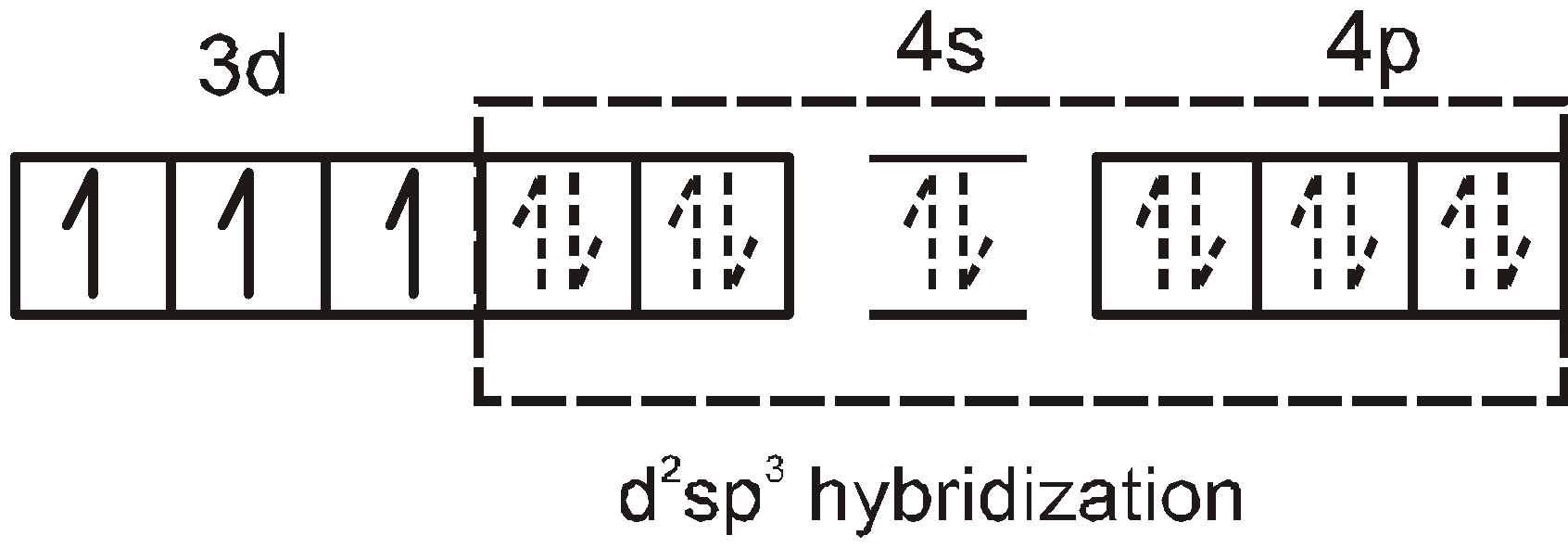
(ii) In both complexes chromium is in +3 oxidation state. Chromium with 3d 3 configuration has 3 unpaired electrons with weak field as well as strong field ligand. So, the hybridisation scheme is as follow :
 (iii) μ =
  =
= 
(iv) EAN = 24 – 3 + 12 = 33
(v) Yes, both have two ions per formula unit.
(vi) AgCl + 2NH 3  [Ag(NH 3 ) 2 ]Cl ; AgBr + 2NH 3
  [Ag(NH 3 ) 2 ]Br
Prepare Smarter with CGP Edu
Get practice questions, solutions, and test series in one place.
Write a Review
Share your experience with this question and solution.
Commentary
Send your comment, doubt, correction, or feedback to admin.
Similar Questions
Explore conceptually related problems