The type of hybridization and the magnetic property of  are,
are,
 , paramagnetic with four unpaired electrons.
 , paramagnetic with four unpaired electrons.
  , paramagnetic with two unpaired electrons.
  , paramagnetic with two unpaired electrons.
Text Solution
Verified by ExpertsA
Determine the oxidation state of manganese in  :
:
Chloride (Cl -1 ) has a charge of -1.
With six chloride ions, the total charge contributed by the ligands is  .
.
Let the oxidation state of Mn be  . Then:
 .
.
So, manganese is in the +3 oxidation state.
Find the d-electron count for Mn(III):
The neutral manganese atom has the electronic configuration  .
.
Removing three electrons (first from the 4s, then from the 3d) gives:
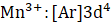 .
.
Therefore,  is a
is a  system.
Predict the spin state in an octahedral complex:
Chloride (Cl -1 ) is a weak-field ligand, meaning it produces a relatively small crystal field splitting (  ).
).
When  is small, the pairing energy is higher than
  , so electrons prefer to remain unpaired.
For a  configuration in a high-spin octahedral complex, the electrons will be distributed as:
Three electrons in the three  orbitals (one in each)
One electron in one of the  orbitals
This results in a total of 4 unpaired electrons, making the complex paramagnetic.
Determine the type of hybridization:
In octahedral complexes, the two common hybridizations are:
 (inner orbital complex), typically seen in low-spin complexes where inner 3d orbitals are available because the electrons are paired.
 (outer orbital complex), seen in highspin complexes where the inner
  orbitals are occupied by unpaired electrons.
Since  is high-spin (because of Cl -1 being a weak-field ligand), the inner 3d orbitals are not available for hybridization.
Therefore, the complex uses the outer orbitals (the 4s, 4p, and 4d orbitals), leading to an  hybridization.
Conclusion:
The hybridization of  is
is  .
.
It is paramagnetic with four unpaired electrons.
Thus, the correct answer is:
Option a:  , paramagnetic with four unpaired electrons.
Prepare Smarter with CGP Edu
Get practice questions, solutions, and test series in one place.
Write a Review
Share your experience with this question and solution.
Commentary
Send your comment, doubt, correction, or feedback to admin.
Similar Questions
Explore conceptually related problems