Find the area enclosed by the x- axis and the curve which passes through the point (0, 2) and satisfies the differential equation x  –2y
–2y  –x = 0
Text Solution
Verified by ExpertsCHECK THE SOLUTION.
Sol. We have,
x  –2y
–2y  –x = 0
⇒  =
= 
⇒  =
= 
This is a homogeneous differential equation. Putting y= vx and  = v + x
  , it reduces to v + x
  = v ±
= v ± 
⇒ x  = ±
= ± 
⇒  = ±
= ± 
⇒ log (v +  ) = ±log x + log C
⇒ v +  = Cx or, v +
  =
= 
⇒ y + = Cx 2 or, y +
 = C
= C
⇒ (Cx 2 –y) 2 = x 2 + y 2 or, (C –y) 2 = x 2 + y 2 ⇒ C
2 x 4 –2C x 2 y = x 2 or, C 2 –2cy = x 2 ⇒ C
2 x 2 –2Cy = 1 or, x 2 + 2Cy –C 2 = 0
⇒ x 2 –  y –
y –  = 0 or, x 2 + 2Cy –C 2 = 0
Since the curve passes through (0, 2). Therefore,
x 2 –  y –
y –  = 0 ⇒ –
  –
– = 0 ⇒ C = –

and, x 2 + 2Cy –C 2 = 0 ⇒ 4C –C 2 = 0 ⇒ C = 4
substituting these values of C in the respective equations, we obtain the equation of the required curve as
x 2 + 8y –16 = 0 ⇒ x 2 = –8 (y –2)
This represents a parabola opening downwards and cutting x- axis at (±4, 0). The shaded region in fig. represents the required area. We slice this region into vertical strips. For the approximating rectangle shown in fig. We have
Length = y, width= Δ x, Area = y Δ x
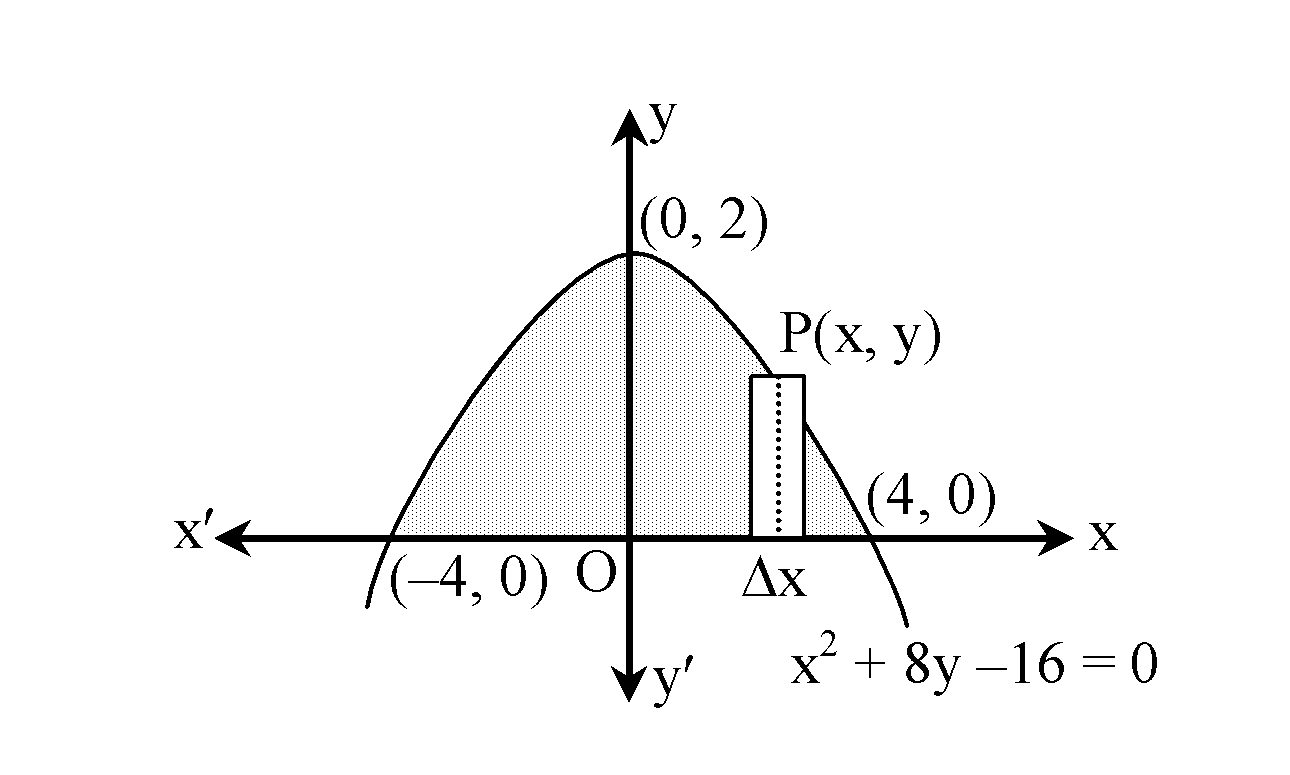
As the approximating rectangle can move between x = –4 and x = 4. So,
Required area = 
= 
= 2 
= 2 
=  sq. units.
Prepare Smarter with CGP Edu
Get practice questions, solutions, and test series in one place.
Write a Review
Share your experience with this question and solution.
Commentary
Send your comment, doubt, correction, or feedback to admin.
Similar Questions
Explore conceptually related problems