Published by:
CGP EDU Academic Team
Published on: August 14, 2026
For a non-zero complex number z, let arg(z) denote the principal argument with –π < arg(z)  π. Then, which of the following statement(s) is (are)
A
Arg(–1 –i) =  , where i =
, where i =
B
The function f : R → (–π, π], defined by f(t) = arg(–1 + it) for all t ∈ R, is continuous at all points of R, where i = 
C
For any two non-zero complex numbers z 1 and z 2 ,  is an integer multiple of 2π
is an integer multiple of 2π
D
For any three given distinct complex numbers z 1 , z 2 and z 3 , the locus of the point z satisfying the condition arg  = π, lies on a straight line.
= π, lies on a straight line.
Text Solution
Verified by ExpertsThe correct answer is:
CHECK THE SOLUTION.
(a, b, d)
Sol. Arg (–1 –i) = – 
f(t) = Arg(–1 + it)
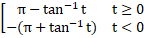
It is discontinuous at t = 0
Arg  – Arg z 1 + Argz 2
Arg  = Arg z 1 – Arg z 2 + 2nπ
so the expression becomes 2nπ
Arg  = π
= π

It is circle
──────────────────────────────────────────────────────────────────────────────────────────
Prepare Smarter with CGP Edu
Get practice questions, solutions, and test series in one place.
Write a Review
Share your experience with this question and solution.
Commentary
Send your comment, doubt, correction, or feedback to admin.
Similar Questions
Explore conceptually related problems
Let . Then the value of at is
Let z = x + iy be a complex number where x and y are integers. Then the area of the rectangle whose…
Let and be two distinct complex numbers and let for some real number with . If denotes the pr…
Let ω be the complex number cos + i sin . Then the number of distinct complex numbers z satisfyin…
Match the statements in List I with those in List II [Note: Here takes the values in the complex p…
If z is any complex number satisfying |z – 3 – 2i| 2, then the minimum value of |2z – 6 + 5i| is