Consider three sets E 1 = {1, 2, 3}, F 1 = {1, 3, 4} and G 1 = {2, 3, 4, 5}. Two elements are chosen at random, without replacement, from the set E 1 and let S 1 denote the set of these chose elements. Let E 2 = E 1 – S 1 and F 2 = F 1  S 1 . Now two elements are chosen at random, without replacement, from the set F 2 and let S 2 denote the set of these chosen elements.
Let G 2 = F 1  S 2 . Finally, two elements are chosen at random, without replacement, from the set G 2 and let S 3 denote the set of these chosen elements.
Let E 3 = E 2  S 3 . Given that E 1 = E 3 , let p be the conditional probability of the event S 1 = {1, 2}. Then the value of p is




Text Solution
Verified by ExpertsA
S 1 F 2 = F 1  S 1 S 2 G 1
  S 2 = G 2 S 3
(i) {1,2} {1,2,3,4) {1,x} {1,2,3,4,5} {1,2}
(ii) {2,3} {1,2,3,4} {1,x} {1,2,3,4,5} {2,3} {x, y} (where x and y or {2, 3, 4,5}
(iii) {1,3} {1,3,4} {1,x} are other than 1) {1,2,3,4,5} {1,3}
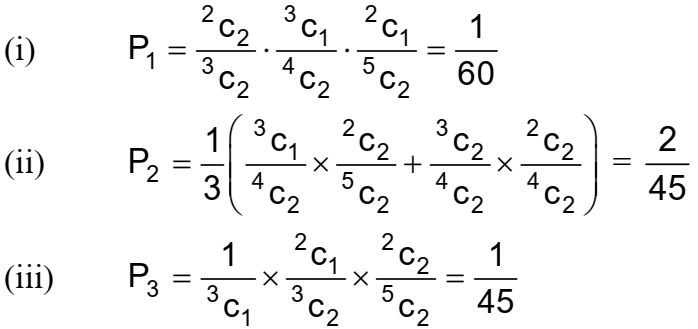
Conditional probability 
──────────────────────────────────────────────────────────────────────────────────────────
Prepare Smarter with CGP Edu
Get practice questions, solutions, and test series in one place.
Write a Review
Share your experience with this question and solution.
Commentary
Send your comment, doubt, correction, or feedback to admin.
Similar Questions
Explore conceptually related problems