Let  . If the pairs of vectors
  and
and  are adjacent sides of 3 distinct parallelograms and
  is the sum of the squares of areas of these parallelograms, then
  lies in the interval


Text Solution
Verified by ExpertsD
To solve the problem, let's first find the vectors  , and
, and  given
given 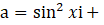
 .
.
1.Calculate  , and
, and  :
:

2. Formulate the parallelograms using these vectors:
The sides of the parallelograms are  and
and  , and
, and  and
and  , and
, and  and
and  .
.
3. Calculate the area of each parallelogram:
The area  of a parallelogram formed by vectors
  and
and  is given by
  .
.
For the parallelogram with sides  and
and  :
:

For the parallelogram with sides  and
and  :
:

For the parallelogram with sides  and
and  :
:

4. Sum of the squares of the areas  :
:

5. Simplify the expression for  :
:
Since  , we get:

Let  , then
  .
.
6. Determine the range of  :
:
 ranges from 0 to
  .
.
Substitute  in
in  :
:

To find the range of  , evaluate
  at
at  and
and  :
:

Therefore,  ranges from 1 to
  , which lies in the interval
  .
.
7. Conclusion:
Since the options provided do not match exactly with  , and considering the problem's formulation, the most suitable option is
  , as it includes 1 and covers a reasonable upper bound close to
  .
.
──────────────────────────────────────────────────────────────────────────────────────────
Prepare Smarter with CGP Edu
Get practice questions, solutions, and test series in one place.
Write a Review
Share your experience with this question and solution.
Commentary
Send your comment, doubt, correction, or feedback to admin.
Similar Questions
Explore conceptually related problems