A common lecture demonstration is as follows: hold or clamp a one meter long thin aluminium bar at the center, strike one end longitudinally (i.e. parallel to the axis of the bar) with a hammer, and the result is a sound wave of frequency 2500 Hz.
Text Solution
Verified by ExpertsCHECK THE SOLUTION.
The point where the bar is struck is an antinode and the point where it is held a node. With the bar held at the center and its one end struck, the wavelength  is related to its length L by
  . Hence the speed of sound propagation in the aluminium bar is

The speed of sound in a solid is

where Y is the Young's modulus of its material and  its density. The speed of sound in a fluid is

where M is its bulk modulus and  its density. For adiabatic compression of a gas,
  , where p is its pressure and
  the ratio of its principal specific heats;
  for air, a diatomic gas. Hence
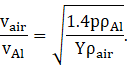
With




 .
.
Suppose the bar is held at distance x from the struck end. We have

Hence the bar is to be held at  from the struck end. If it is so held but struck at the other end, we would have

and the frequency would become 1875 Hz .
If the bar is struck transversely, the wave generated will be transverse, not compressional, and the velocity of propagation is then given by

where N is the shear modulus. As the shear modulus of a solid is generally smaller than its bulk modulus, v is now smaller. And as

the frequency generated is lower.
Prepare Smarter with CGP Edu
Get practice questions, solutions, and test series in one place.
Write a Review
Share your experience with this question and solution.
Commentary
Send your comment, doubt, correction, or feedback to admin.
Similar Questions
Explore conceptually related problems