An acoustical motion detector emits a 50 kHz signal and receives the echo signal. If the echoes have Doppler shift frequency components departing from 50 kHz by more than 100 Hz, a "moving object" is registered. For a sound velocity in air of 330 m/sec, calculate the speed with which an object must move toward (or away from) the detector in order to be registered as a "moving object".
Text Solution
Verified by ExpertsCHECK THE SOLUTION.
Consider a source emitting sound of frequency v. The Doppler effect has it that if an observer moves with velocity v toward the source he will detect the frequency as
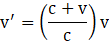
c being the speed of sound propagation. On the other hand, if the source moves with velocity v toward the observer, who is stationary, then
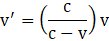
Thus the object, moving toward the detector, receives a signal of frequency
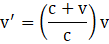
and the signal after reflection by the object is detected by the detector as having frequency
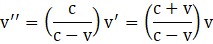
For the moving object to be registered, we must have  , where
  . Then
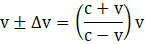
Or
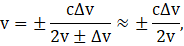
as  . Hence the object must be moving toward or receding from the detector at
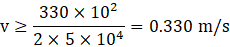
for it to be registered.
Prepare Smarter with CGP Edu
Get practice questions, solutions, and test series in one place.
Write a Review
Share your experience with this question and solution.
Commentary
Send your comment, doubt, correction, or feedback to admin.
Similar Questions
Explore conceptually related problems