A long hollow cylindrical conductor with inner radius a and outer radius b carries a current I uniformly distributed over the cross-sectional area of the conductor (see fig.).
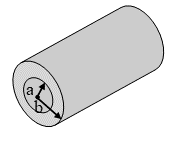
Use Ampere's law to show that the magnitude of the magnetic field at a radius r from the axis of the conductor is zero if r < a and 

 if b < r < a and equal to
  if r > b.
Text Solution
Verified by ExpertsCHECK THE SOLUTION.
Sol. Due to symmetry of the conductor we expect magnetic field lines to be circular. Therefore we choose a circular closed curve of radius r < a. From Ampere's law,
 = B2 π r = µ0I encl
As I encl = 0, B (r < a) = 0
Current density j =  inside the conductor. Now we take a circular closed curve in the region a < r < b. Then current enclosed by curve,
I incl = (j) [ π (r 2 – a 2 )]
= 
From Ampere's law,
The Magnetic Field
 = B2 π r = µ 0
B = 
For a circular closed curve outside the conductor (r > b),
 = B2 π r = µ 0 I
B = 
As total current is enclosed in our circular loop.
Prepare Smarter with CGP Edu
Get practice questions, solutions, and test series in one place.
Write a Review
Share your experience with this question and solution.
Commentary
Send your comment, doubt, correction, or feedback to admin.
Similar Questions
Explore conceptually related problems