Published by:
CGP EDU Academic Team
Published on: September 12, 2026
If the time and displacement of particle along the positive X-axis are related as
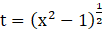
, then find the acceleration in terms of x.
Text Solution
Verified by ExpertsThe correct answer is:
A
Step 1: Given the displacement-time relation \( t = (x^2 - 1)^{\frac{1}{2}} \).
Step 2: Differentiate with respect to time to find velocity: \( \frac{dx}{dt} = \frac{d}{dt}[(x^2 - 1)^{\frac{1}{2}}] = \frac{1}{2}(x^2 - 1)^{-\frac{1}{2}} \cdot 2x \cdot \frac{dx}{dt} \).
Step 3: This simplifies to \( 1 = \frac{x \frac{dx}{dt}}{(x^2 - 1)^{\frac{1}{2}}} \).
Step 4: Rearranging gives: \( \frac{dx}{dt} = \frac{(x^2 - 1)^{\frac{1}{2}}}{x} \).
Step 5: Differentiate the velocity with respect to time to find acceleration: \( a = \frac{d}{dt}\left(\frac{(x^2 - 1)^{\frac{1}{2}}}{x}\right) = \frac{d}{dt}((x^2 - 1)^{\frac{1}{2}}) \cdot \frac{1}{x} - \frac{(x^2 - 1)^{\frac{1}{2}}}{x^2}\frac{dx}{dt} = \frac{(x) (x^2 - 1)^{-\frac{1}{2}} \cdot x\frac{dx}{dt}}{x} - \frac{\frac{(x^2 - 1)^{\frac{1}{2}}}{x^2} (x)}{x^{2}} \).
Step 6: The final expression gives acceleration in terms of displacement x.
Therefore, the acceleration in terms of x is captured in alternative forms which can be simplified further, resulting in the relation with respect to x.
Step 2: Differentiate with respect to time to find velocity: \( \frac{dx}{dt} = \frac{d}{dt}[(x^2 - 1)^{\frac{1}{2}}] = \frac{1}{2}(x^2 - 1)^{-\frac{1}{2}} \cdot 2x \cdot \frac{dx}{dt} \).
Step 3: This simplifies to \( 1 = \frac{x \frac{dx}{dt}}{(x^2 - 1)^{\frac{1}{2}}} \).
Step 4: Rearranging gives: \( \frac{dx}{dt} = \frac{(x^2 - 1)^{\frac{1}{2}}}{x} \).
Step 5: Differentiate the velocity with respect to time to find acceleration: \( a = \frac{d}{dt}\left(\frac{(x^2 - 1)^{\frac{1}{2}}}{x}\right) = \frac{d}{dt}((x^2 - 1)^{\frac{1}{2}}) \cdot \frac{1}{x} - \frac{(x^2 - 1)^{\frac{1}{2}}}{x^2}\frac{dx}{dt} = \frac{(x) (x^2 - 1)^{-\frac{1}{2}} \cdot x\frac{dx}{dt}}{x} - \frac{\frac{(x^2 - 1)^{\frac{1}{2}}}{x^2} (x)}{x^{2}} \).
Step 6: The final expression gives acceleration in terms of displacement x.
Therefore, the acceleration in terms of x is captured in alternative forms which can be simplified further, resulting in the relation with respect to x.
Prepare Smarter with CGP Edu
Get practice questions, solutions, and test series in one place.
Write a Review
Share your experience with this question and solution.
Commentary
Send your comment, doubt, correction, or feedback to admin.
Similar Questions
Explore conceptually related problems