Published by:
CGP EDU Academic Team
Published on: September 12, 2026
A particle is moving with velocity

, where
is in
and
is in seconds. At what time will the velocity be maximum/minimum and what is it equal to?
Text Solution
Verified by ExpertsThe correct answer is:
B
Step 1: Given the velocity function:
$$ v(t) = t^3 - 6t^2 + 4 $$
Step 2: To find the time when the velocity is maximum or minimum, we need to calculate the first derivative of the velocity function with respect to time \( t \):
$$ \frac{dv}{dt} = 3t^2 - 12t $$
Step 3: Set the first derivative to zero to find critical points:
$$ 3t^2 - 12t = 0 $$
Step 4: Factor the equation:
$$ 3t(t - 4) = 0 $$
This gives the critical points: \( t = 0 \) and \( t = 4 \).
Step 5: Now we will find the second derivative to determine the nature of these critical points:
$$ \frac{d^2v}{dt^2} = 6t - 12 $$
Step 6: Evaluate the second derivative at the critical points:
- For \( t = 0 \):
$$ \frac{d^2v}{dt^2} = 6(0) - 12 = -12 \; (\text{max}) \implies \text{local maximum} $$
- For \( t = 4 \):
$$ \frac{d^2v}{dt^2} = 6(4) - 12 = 12 \; (\text{min}) \implies \text{local minimum} $$
Step 7: Now we find the values of velocity at these critical points:
- At \( t = 0 \):
$$ v(0) = 0^3 - 6(0)^2 + 4 = 4 \; \text{(max)} $$
- At \( t = 4 \):
$$ v(4) = 4^3 - 6(4^2) + 4 = 64 - 96 + 4 = -28 \; \text{(min)} $$
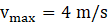
Thus, the velocity will be maximum (4 m/s) at t = 0 seconds and minimum (-28 m/s) at t = 4 seconds.
$$ v(t) = t^3 - 6t^2 + 4 $$
Step 2: To find the time when the velocity is maximum or minimum, we need to calculate the first derivative of the velocity function with respect to time \( t \):
$$ \frac{dv}{dt} = 3t^2 - 12t $$
Step 3: Set the first derivative to zero to find critical points:
$$ 3t^2 - 12t = 0 $$
Step 4: Factor the equation:
$$ 3t(t - 4) = 0 $$
This gives the critical points: \( t = 0 \) and \( t = 4 \).
Step 5: Now we will find the second derivative to determine the nature of these critical points:
$$ \frac{d^2v}{dt^2} = 6t - 12 $$
Step 6: Evaluate the second derivative at the critical points:
- For \( t = 0 \):
$$ \frac{d^2v}{dt^2} = 6(0) - 12 = -12 \; (\text{max}) \implies \text{local maximum} $$
- For \( t = 4 \):
$$ \frac{d^2v}{dt^2} = 6(4) - 12 = 12 \; (\text{min}) \implies \text{local minimum} $$
Step 7: Now we find the values of velocity at these critical points:
- At \( t = 0 \):
$$ v(0) = 0^3 - 6(0)^2 + 4 = 4 \; \text{(max)} $$
- At \( t = 4 \):
$$ v(4) = 4^3 - 6(4^2) + 4 = 64 - 96 + 4 = -28 \; \text{(min)} $$
Thus, the velocity will be maximum (4 m/s) at t = 0 seconds and minimum (-28 m/s) at t = 4 seconds.
Prepare Smarter with CGP Edu
Get practice questions, solutions, and test series in one place.
Write a Review
Share your experience with this question and solution.
Commentary
Send your comment, doubt, correction, or feedback to admin.
Similar Questions
Explore conceptually related problems