Critical constant of A gas
When pressure is incerases at constant temp volume of gas decreases
AB → gases, BC → vapour + liquid, CD → liquid
critical point : At this point all the physical properties of liquid phase will be same as the physical properties in vapour such as, density of liquid = density of vapour
T C or critical temp : Temperature above which a gas can not be liquified
P C or critical pressure : minimum pressure which must be applied at critical temp to convert the gas into liquid.
V C or critical volume : volume occupied by one mole of gas at T C & P C

CRITICAL CONSTANT USING VANDER WAAL EQUATIONS :
 (V m – b) = RT ⇒ (
  ) (V m – b) = RT V m 2
PV m 3 + aV m – PbV m 2 – ab – RTV m 2 = 0 ⇒ V m 3 + V m 2  +
+  –
–  = 0
= 0
Since equation is cubic in V m hence there will be three roots of equation at any temperature and pressure.
At critical point all three roots will coincide and will give single value of V m = V c
at critical point, Vander Waal equation will be
V m 3 – V m 2  +
+  V m –
V m –  = 0 ...
Text Solution
Verified by ExpertsCHECK THE SOLUTION.
(i) At critical point,
 = 0 ⇒ –
  +
+  –
–  = 0 ⇒ – RT C +
  –
–  = 0 ⇒ RT C V 2 m – 2BV m + 3C = 0
as equation will have repeated root then D = 0 ⇒ T C = 
(ii) P C , V C and T C are given hence ‘a’ and ‘b’ should be calculated using P C and T C as it is more reliable.
P C =  , T C =
 =
=  ⇒ b =
⇒ b =  =
= 
(iii) 4 ×  π r 3 . N A =
  ⇒ r =
⇒ r = 
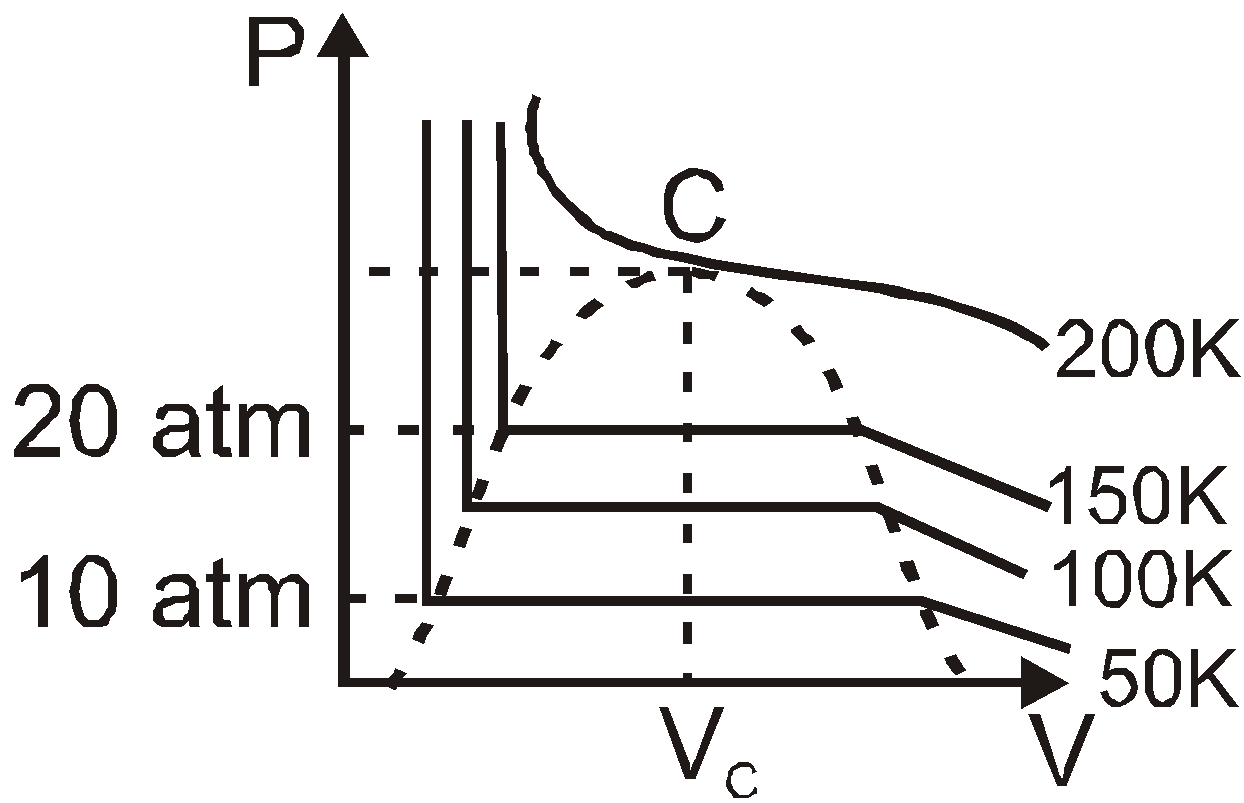
At 100 K and pressure below 20 atm it may have liquid or gaseous state depending on the pressure
Prepare Smarter with CGP Edu
Get practice questions, solutions, and test series in one place.
Write a Review
Share your experience with this question and solution.
Commentary
Send your comment, doubt, correction, or feedback to admin.
Similar Questions
Explore conceptually related problems