Two models are considered to explain metallic bonding :
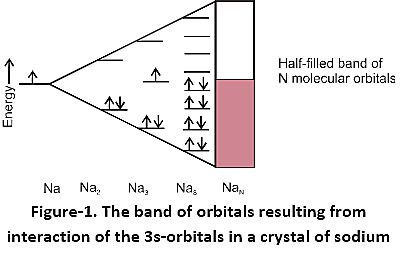
The interaction of two atomic orbitals, say the 3s-orbitals of two sodium atoms, produces two molecular orbitals, one bonding orbital and one antibonding orbital. If N atomic orbitals interact, N molecular orbitals are formed. Atoms interact more strongly with nearby atoms than with those farther away. The energy that separates bonding and antibonding molecular orbitals decreases as the interaction (overlap) between the atomic orbitals decreases. When we consider all the possible interactions among one mole of Na atoms, there is formation of series of very closely spaced molecular orbitals (3σs and |
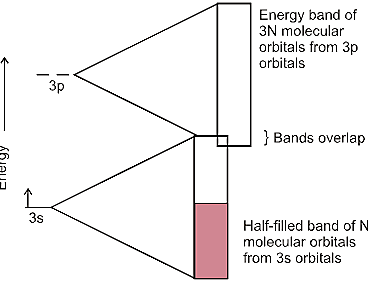
The empty 3 p atomic orbitals of Na atoms also interact to form a wide band of 3 × 6.07 × 1023 orbitals. Figure-2. Overlapping of a half–filled “3s” band with an empty “3p” band of NaN crystal According to band theory, the highest-energy electrons of metallic crystals occupy either a partially filled band or a filled band that overlaps an empty band. A band within which (or into which) electrons must move to allow electrical conduction is called a conduction band. The electrical conductivity of a metal decreases as temperature increases. The increase in temperature causes thermal agitation of the metal ions. This impedes the flow of electrons when an electric field is applied. |
Text Solution
Verified by ExpertsCHECK THE SOLUTION.
(i)d (ii)c (iii)d
Prepare Smarter with CGP Edu
Get practice questions, solutions, and test series in one place.
Write a Review
Share your experience with this question and solution.
Commentary
Send your comment, doubt, correction, or feedback to admin.
Similar Questions
Explore conceptually related problems