Section 3 (Maximum Marks: 24)
• This section contains SIX (06) questions. The answer to each question is a NUMERICAL VALUE
• For each question, enter the correct numerical value of the answer using the mouse and on-screen virtual numerical keypad in the place designated to enter the answer. If the numerical value has more than tow decimal places, truncate/round-off the value to TWO decimal places.
• Answer to each question will be evaluated according to the following marking scheme:
Full Marks : +4 If ONLY the correct numerical value is entered;
Zero Marks : 0 If all the cases.
Put a uniform meter scale horizontally on your extended index fingers with the left one at 0.00 cm and the right one at 90.00 cm. When you attempt to move both the fingers slowly towards the center, initially only the left finger slips with respect to the scale and the right finger does not. After some distance, the left finger stops and the right one starts slipping. Then the right finger stops at a distance x r from the center (50.00 cm) of the scale and the left one starts slipping again. This happens because of the difference in the frictional forces on the two fingers. If the coefficients of static and dynamic friction between the fingers and the scale are 0.40 and 0.32, respectively, the value of x r (in cm) is______.
Text Solution
Verified by ExpertsCHECK THE SOLUTION.
(25.6 ,25.60 to 25.60)
Initially
40N 1 = 50N 2
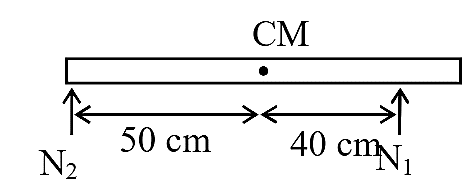
For first move
 ….(i)
….(i)
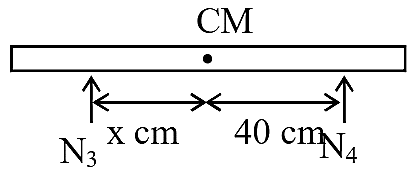
xN 3 = 40 N 4 ... (ii)
x = 32cm
For second move
 …(i)
…(i)
 ...(ii)
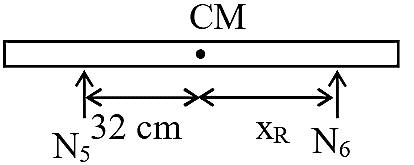
x=32cm
For second move
 …(i)
…(i)
 …(ii)
…(ii)

──────────────────────────────────────────────────────────────────────────────────────────
Prepare Smarter with CGP Edu
Get practice questions, solutions, and test series in one place.
Write a Review
Share your experience with this question and solution.
Commentary
Send your comment, doubt, correction, or feedback to admin.
Similar Questions
Explore conceptually related problems