For what values of  , the equation
 has
has 
(i) both roots are imaginary?
(ii) both roots are equal?
(iii) both roots are real and distinct?
(iv) both roots are positive?
(v) both roots are negative?
(vi) roots are opposite in sign?
(vii) roots are equal in magnitude but opposite in sign?
(viii) atleast one root is positive?
(ix) atleast one root is negative?
(x) roots are in the ratio 2:3?
Text Solution
Verified by ExpertsCHECK THE SOLUTION.


(i) Both roots are imaginary.



(ii) Both roots are equal.


(iii) Both roots are real and distinct.




(iv) Both roots are positive.
Case I Sum of the roots > 0
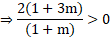

Case II Product of the roots 
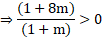
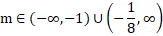
Case III 


Combining all Cases, we get

(v) Both roots are negative.
Consider the following cases:
Case I Sum of the roots 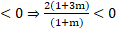
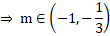
Case II Product of the roots 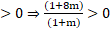
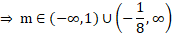
Case III 

Combining all cases, we get

(vi) Roots are opposite in sign, then
Case I Consider the following cases:
Product of the roots < 0
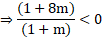

Case II 

Combining all cases, we get

(vii) Roots are equal in magnitude but opposite in sign, then Consider the following cases:
Case I Sum of the roots 





Combining all cases, we get

(viii) Atleast one root is positive, then either one root is positive or both roots are positive. i.e. part (iv)  vi
vi 
or 
(ix) Atleast one root is negative, then either one root is negative or both roots are negative.
i.e.  or
or 
(x) Let roots be  and
and  . Then,
Consider the following cases:
Case I Sum of the roots 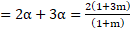
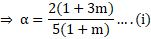
Case II Product of the roots
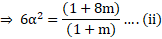
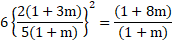
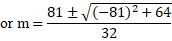
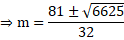
From Eqs. (i) and (ii), we get


──────────────────────────────────────────────────────────────────────────────────────────
Prepare Smarter with CGP Edu
Get practice questions, solutions, and test series in one place.
Write a Review
Share your experience with this question and solution.
Commentary
Send your comment, doubt, correction, or feedback to admin.
Similar Questions
Explore conceptually related problems