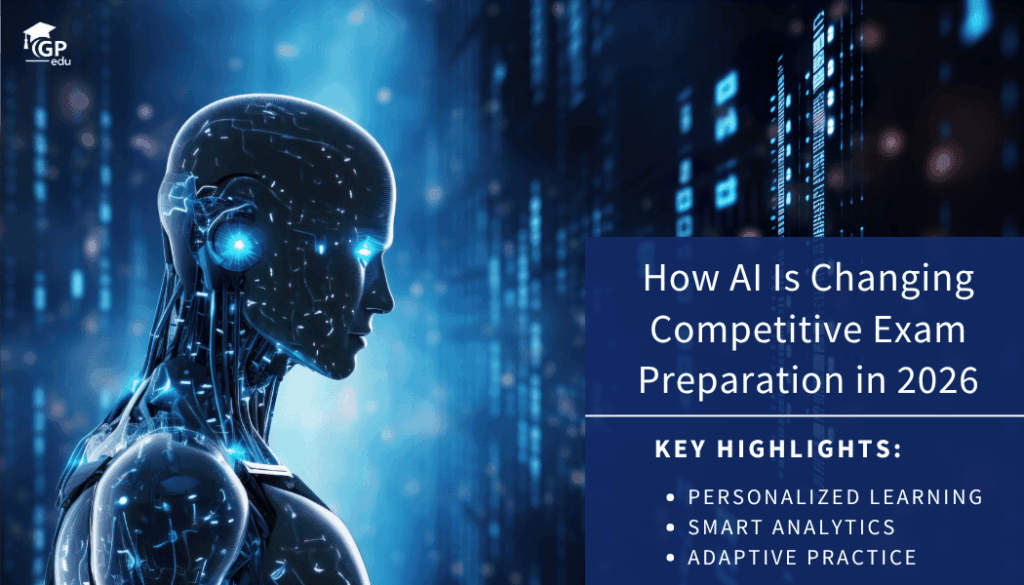
How AI Is Changing Competitive Exam Preparation in 2026
Education has always evolved with technology, but the pace of change in the last few years has been remarkable. Artificial intelligence, once associated mainly with software development and automation, is now becoming a powerful tool in education.
For students preparing for competitive exams like JEE, NEET, CUET, and international tests, AI powered learning platforms are reshaping the way preparation happens. Instead of following a rigid one size fits all curriculum, students now have access to systems that adapt to their pace and learning style.
In 2026, AI is not replacing teachers. Instead, it is helping educators deliver more personalized and efficient learning experiences.
Why Traditional Study Methods Are Evolving
Growing Competition in Entrance Exams
The number of aspirants appearing for major entrance exams increases every year. With limited seats in top institutions, students must optimize every aspect of their preparation.
Traditional coaching models often struggle to provide individualized feedback to every learner. This is where AI based learning tools begin to make a difference.
The Need for Personalized Study Plans
No two students prepare in exactly the same way. Some grasp concepts quickly but struggle with consistency. Others are disciplined but need additional help understanding difficult topics.
AI driven systems analyze performance patterns and suggest personalized study plans. These recommendations help students focus on topics where improvement is needed the most.
How AI Is Being Used in Competitive Exam Preparation
Performance Analytics and Progress Tracking
One of the most powerful features of AI based learning systems is performance analytics.
Instead of simply showing scores, modern platforms analyze:
- Accuracy percentage
- Time spent per question
- Topic wise strengths and weaknesses
- Patterns of repeated mistakes
This data allows students and mentors to identify gaps more effectively.
A deeper explanation of how performance tracking improves exam preparation can be found in our Mock Test Strategy for Competitive Exams blog.
Adaptive Practice Questions
AI platforms can adjust question difficulty depending on student performance.
For example:
- Students performing well receive more challenging questions
- Students struggling with concepts receive foundational practice
This adaptive learning approach ensures that students are neither overwhelmed nor under challenged.
Smart Revision Planning
One of the biggest challenges in competitive exam preparation is managing revision cycles.
AI powered systems help schedule revision sessions based on memory retention patterns. Topics that students are likely to forget are automatically reintroduced at the right time.
This method helps improve long term retention without increasing study hours significantly.
AI and the Rise of Hybrid Learning
Artificial intelligence works best when combined with human mentorship. The most effective learning environments today combine technology with expert teaching.
This model is often called hybrid learning. It includes:
- Live classes with teachers
- Recorded lectures for revision
- AI based performance tracking
- Personalized mentoring
A detailed explanation of this model can be found in our Hybrid Learning for JEE and NEET Preparation blog, which explores how technology and teaching complement each other.
Benefits of AI Powered Learning for Students
Faster Identification of Weak Areas
Instead of discovering weaknesses during final exams, students can identify them early through analytics.
For instance, if a student consistently struggles with rotational mechanics in Physics or organic reaction mechanisms in Chemistry, the system highlights these patterns.
Early intervention leads to more efficient preparation.
Better Time Management
Competitive exams reward not only knowledge but also speed and accuracy.
AI tools track how long students take to solve questions. Based on this data, they recommend practice strategies to improve speed.
Continuous Feedback
In traditional learning environments, feedback may come only after tests or assignments.
AI driven systems provide continuous feedback. Students can review their performance after every practice session and adjust their study strategy accordingly.
Role of Mentors in the Age of AI
Despite technological advances, human mentorship remains essential in education.
Teachers play a critical role in:
- Explaining complex concepts
- Motivating students during challenging phases
- Providing emotional support
- Designing long term preparation strategies
Technology enhances these processes but cannot replace the insight and experience of skilled educators.
CGP Edu integrates advanced learning tools with personalized mentoring. Students benefit from structured guidance, live concept sessions, and detailed performance analysis.
Parents and students can explore CGP Edu’s academic programs on the CGP Edu main website, where personalized coaching models and exam preparation strategies are explained.
Students preparing for Physics, Chemistry, Mathematics, or Biology can also explore CGP Edu’s personalized online classes, designed to combine technology assisted learning with expert mentorship.
Challenges of Over Reliance on AI
While AI offers many benefits, students should avoid relying on it blindly.
Some common risks include:
- Skipping conceptual understanding
- Depending entirely on automated recommendations
- Ignoring fundamental problem solving practice
Technology should support learning rather than replace critical thinking.
Students must still develop independent analytical skills, especially for competitive exams.
The Future of AI in Education
Artificial intelligence will continue to shape the education landscape in the coming years.
Future developments may include:
- More advanced adaptive testing systems
- Improved predictive analytics for exam performance
- Enhanced personalized learning environments
However, the core principle of education will remain the same. Success will still depend on discipline, curiosity, and consistent effort.
Final Thoughts
AI is changing how students prepare for competitive exams, but it is not a shortcut to success. The real advantage of AI lies in its ability to provide insights that help students study more effectively.
When combined with experienced mentors and structured learning plans, AI can make preparation more focused and efficient.
Students who use these tools wisely can improve their understanding, track their progress more clearly, and build the confidence needed to perform well in competitive exams.
FAQs
- How is AI used in education today?
AI is used for performance analytics, adaptive practice questions, and personalized study planning. - Can AI replace teachers in exam preparation?
No. AI supports learning, but teachers provide explanation, mentorship, and motivation. - Do AI based learning platforms improve exam performance?
They can help identify weak areas and improve study efficiency when used properly. - What is adaptive learning in education?
Adaptive learning adjusts question difficulty and study recommendations based on student performance. - Is AI useful for JEE and NEET preparation?
Yes, analytics and personalized practice can improve preparation strategies. - Can students rely only on AI for studying?
No. Conceptual understanding and independent practice remain essential. - Does AI help with revision planning?
Yes, some platforms schedule revision sessions based on memory retention patterns. - Will AI become more common in education?
Yes, AI assisted learning is expected to grow significantly in the coming years.