How many minimum number of coplanar vectors having different magnitudes can be added to give zero resultant
Text Solution
Verified by ExpertsThe correct answer is:
B
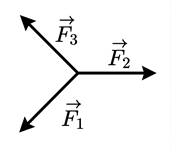
Let  and
and  are two vectors having resultant
  i.e.
i.e.  .
.
This means all the three forces  and lie in the same plane.
Therefore, if there be a vector acting exactly opposite of with two other vectors and , the net force is zero but they must be coplanar
Prepare Smarter with CGP Edu
Get practice questions, solutions, and test series in one place.
Write a Review
Share your experience with this question and solution.
Commentary
Send your comment, doubt, correction, or feedback to admin.
Similar Questions
Explore conceptually related problems
The vector projection of a vector on -axis is
Position of a particle in a rectangular-co-ordinate system is . Then its position vector will be
If a particle moves from point to point . Its displacement vector be
A force of 5 N acts on a particle along a direction making an angle of 60° with vertical. Its verti…
If and , the vector having the same magnitude as and parallel to is
Vector makes equal angles with and axis. Value of its components (in terms of magnitude of ) wi…