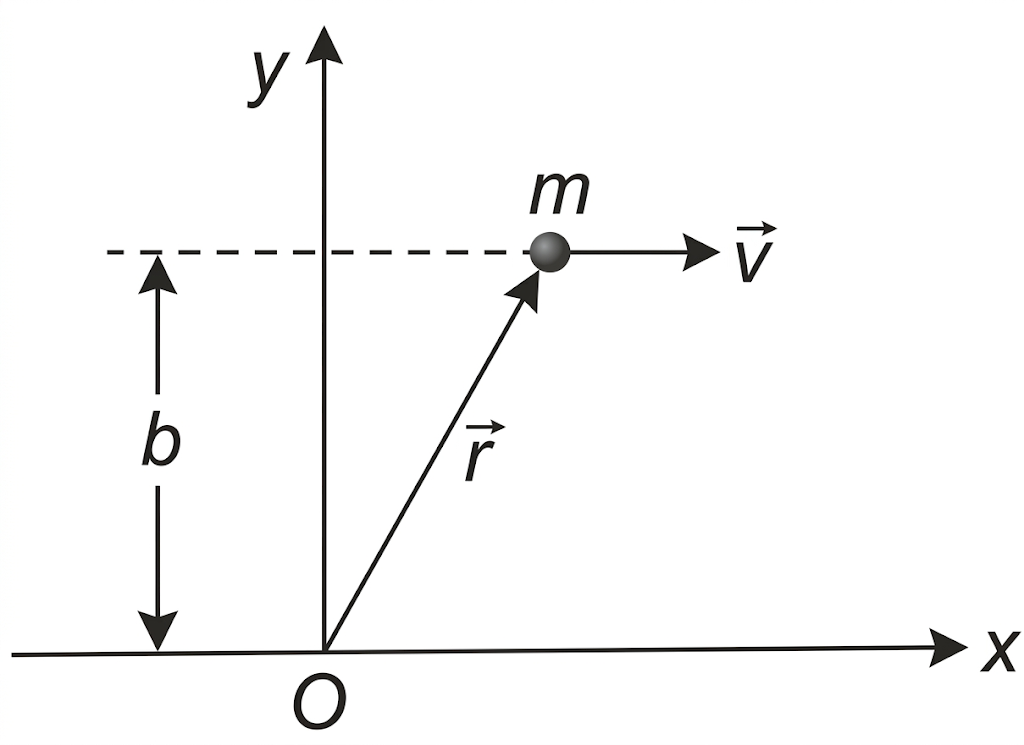
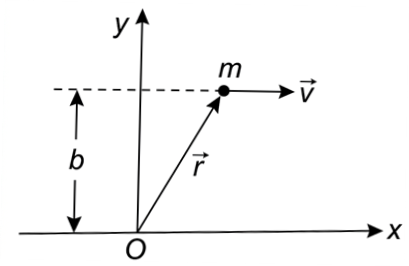
If a particle of mass m is moving with constant velocity v parallel to x-axis in x-y plane as shown in fig. Its angular momentum with respect to origin at any time t will be
A

B

C

D

Text Solution
Verified by ExpertsThe correct answer is:
B
We know that, Angular momentum
 in terms of component becomes
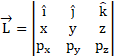
As motion is in x-y plane (z = 0 and  ), so
), so 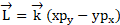
Here x = vt, y = b,  and
and 

Prepare Smarter with CGP Edu
Get practice questions, solutions, and test series in one place.
Write a Review
Share your experience with this question and solution.
Commentary
Send your comment, doubt, correction, or feedback to admin.
Similar Questions
Explore conceptually related problems
If a vector is perpendicular to the vector . Then the value of is
If two vectors and are parallel to each other then value of l λ be
A body, acted upon by a force of 50 N is displaced through a distance 10 meter in a direction makin…
A particle moves from position to due to a uniform force of If the displacement in meters then w…
If for two vector and , sum is perpendicular to the difference . The ratio of their magnitude is
The angle between the vectors and is The value of the triple product is