Two cars are moving in the same direction with the same speed 30 km/hr. They are separated by a distance of 5 km, the speed of a car moving in the opposite direction if it meets these two cars at an interval of 4 minutes, will be
Text Solution
Verified by ExpertsB
The two car (say A and B) are moving with same velocity, the relative velocity of one (say B) with respect to the other 
So the relative separation between them (= 5 km) always remains the same.
Now if the velocity of car (say C) moving in opposite direction to A and B, is  relative to ground then the velocity of car C relative to A and B will be
But as  is opposite to v C
So 
So, the time taken by it to cross the cars A and B 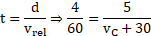

Prepare Smarter with CGP Edu
Get practice questions, solutions, and test series in one place.
Write a Review
Share your experience with this question and solution.
Commentary
Send your comment, doubt, correction, or feedback to admin.
Similar Questions
Explore conceptually related problems