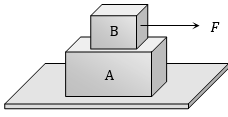
A block B is placed on block A. The mass of block B is less than the mass of block A. Friction exists between the blocks, whereas the ground on which the block A is placed is taken to be smooth. A horizontal force F, increasing linearly with time begins to act on B. The acceleration  and
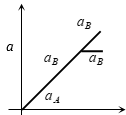
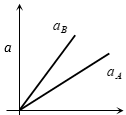
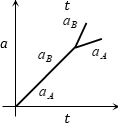
and  of blocks A and B respectively are plotted against t. The correctly plotted graph is
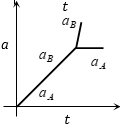
Text Solution
Verified by ExpertsD
If the applied force is less than limiting friction between block A and B, then whole system move with common acceleration
i.e. 
But the applied force increases with time, so when it becomes more than limiting friction between A and B, block B starts moving under the effect of net force F – F k
Where  Kinetic friction between block A and B
 Acceleration of block B,
As F is increasing with time so a B will increase with time
Kinetic friction is the cause of motion of block A
 Acceleration of block A,
It is clear that  . i.e. graph correctly represents the variation in acceleration with time for block A and B.
Prepare Smarter with CGP Edu
Get practice questions, solutions, and test series in one place.
Write a Review
Share your experience with this question and solution.
Commentary
Send your comment, doubt, correction, or feedback to admin.
Similar Questions
Explore conceptually related problems