Published by:
CGP EDU Academic Team
Published on: September 13, 2026
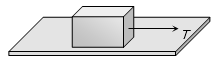
In the figure shown, a block of weight 10 N resting on a horizontal surface. The coefficient of static friction between the block and the surface µ s = 0.4 . A force of 3.5 N will keep the block in uniform motion, once it has been set in motion. A horizontal force of 3 N is applied to the block, then the block will
Text Solution
Verified by ExpertsThe correct answer is:
C
$\mathbf{F}_1 = \mu_s R = 0.4 \times mg = 0.4 \times 10 = 4 \mathrm{N}$ i.e. minimum 4 N force is required to start the motion of a body. But applied force is only 3 N. So, the block will not move.
Prepare Smarter with CGP Edu
Get practice questions, solutions, and test series in one place.
Write a Review
Share your experience with this question and solution.
Commentary
Send your comment, doubt, correction, or feedback to admin.
Similar Questions
Explore conceptually related problems
The coefficient of friction $p_u$ and the angle of friction $\lambda$ are related as
A force of 98 N is required to just start moving a body of mass 100 kg over ice. The coefficient of…
A block weighs W is held against a vertical wall by applying a horizontal force F. The minimum valu…
The maximum static frictional force is
Pulling force making an angle θ to the horizontal is applied on a block of weight W placed on a hor…
Two masses A and B of 10 kg and 5 kg respectively are connected with a string passing over a fricti…