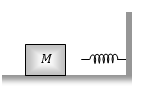
The block of mass M moving on the frictionless horizontal surface collides with the spring of spring constant K and compresses it by length L. The maximum momentum of the block after collision is
A
Zero
B

C

D

Text Solution
Verified by ExpertsThe correct answer is:
C
When block of mass M collides with the spring its kinetic energy gets converted into elastic potential energy of the spring.
From the law of conservation of energy
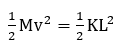


Where v is the velocity of block by which it collides with spring. So, its maximum momentum
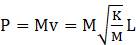 =
= 
After collision the block will rebound with same linear momentum.
Prepare Smarter with CGP Edu
Get practice questions, solutions, and test series in one place.
Write a Review
Share your experience with this question and solution.
Commentary
Send your comment, doubt, correction, or feedback to admin.
Similar Questions
Explore conceptually related problems
Two bodies of masses and have equal kinetic energies. If and are their respective momentum, the…
Work done in raising a box depends on
A light and a heavy body have equal momenta. Which one has greater K.E
A body at rest may have
The kinetic energy possessed by a body of mass m moving with a velocity v is equal to , provided
If the momentum of a body is increased n times, its kinetic energy increases