A body of mass  rises to height
  from the earth's surface, where R is earth's radius. If g is acceleration due to gravity at earth's surface, the increase in potential energy is
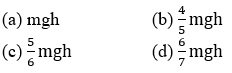
Text Solution
Verified by ExpertsThe correct answer is:
C

Substituting  we get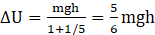
Prepare Smarter with CGP Edu
Get practice questions, solutions, and test series in one place.
Write a Review
Share your experience with this question and solution.
Commentary
Send your comment, doubt, correction, or feedback to admin.
Similar Questions
Explore conceptually related problems
In a gravitational field, at a point where the gravitational potential is zero
The gravitational field due to a mass distribution is in the x-direction. (K is a constant). Takin…
The mass of the earth is and that of the moon is . The constant of gravitation . The potential e…
The change in potential energy, when a body of mass m is raised to a height nR from the earth's sur…
The masses and radii of the earth and moon are and respectively. Their centers are distance d apa…
If mass of earth is M, radius is R and gravitational constant is G, then work done to take 1 kg mas…