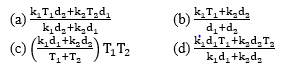
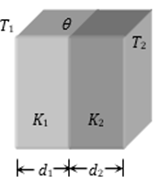
Two walls of thicknesses d 1 and d 2 and thermal conductivities k 1 and k 2 are in contact. In the steady state, if the temperatures at the outer surfaces are  and
and  , the temperature at the common wall is
Text Solution
Verified by ExpertsThe correct answer is:
A
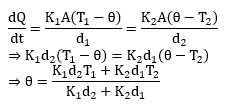
In series both walls have same rate of heat flow. Therefore
Prepare Smarter with CGP Edu
Get practice questions, solutions, and test series in one place.
Write a Review
Share your experience with this question and solution.
Commentary
Send your comment, doubt, correction, or feedback to admin.
Similar Questions
Explore conceptually related problems
In which case the thermal conductivity increases from left to right
Which of the following cylindrical rods will conduct most heat, when their ends are maintained at t…
The heat is flowing through two cylindrical rods of same material. The diameters of the rods are in…
Two identical square rods of metal are welded end to end as shown in figure (i), 20 calories of hea…
For cooking the food, which of the following type of utensil is most suitable
Under steady state, the temperature of a body