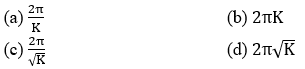
The equation of motion of a particle is 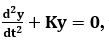 where K is positive constant. The time period of the motion is given by
Text Solution
Verified by ExpertsThe correct answer is:
C

Prepare Smarter with CGP Edu
Get practice questions, solutions, and test series in one place.
Write a Review
Share your experience with this question and solution.
Commentary
Send your comment, doubt, correction, or feedback to admin.
Similar Questions
Explore conceptually related problems
A particle moves such that its acceleration is given by , where is the displacement from equilib…
A tunnel has been dug through the centre of the earth and a ball is released in it. It will reach t…
The maximum speed of a particle executing S.H.M. is and its maximum acceleration is . The time pe…
The motion of a particle executing S.H.M. is given by , where x is in meters and time is in second…
The kinetic energy of a particle executing S.H.M. is 16 J when it is in its mean position. If the a…
The acceleration of a particle performing S.H.M. is at a distance of from the mean position. Its …